Classical guitars stop at 19 frets. Most acoustics stop at 20. Electrics come with 21, 22, or 24. Those numbers look like a ranking at first glance, as if more frets meant a better guitar, but the count is not a quality score. It is a design choice, shaped by the body of the instrument, the style of music it was built for, and how far a player’s hand can usefully reach. Understanding what frets do, and why the counts differ, makes the numbers easy to read on any guitar in a shop or in your own hands.
What a Fret Actually Does to a Note
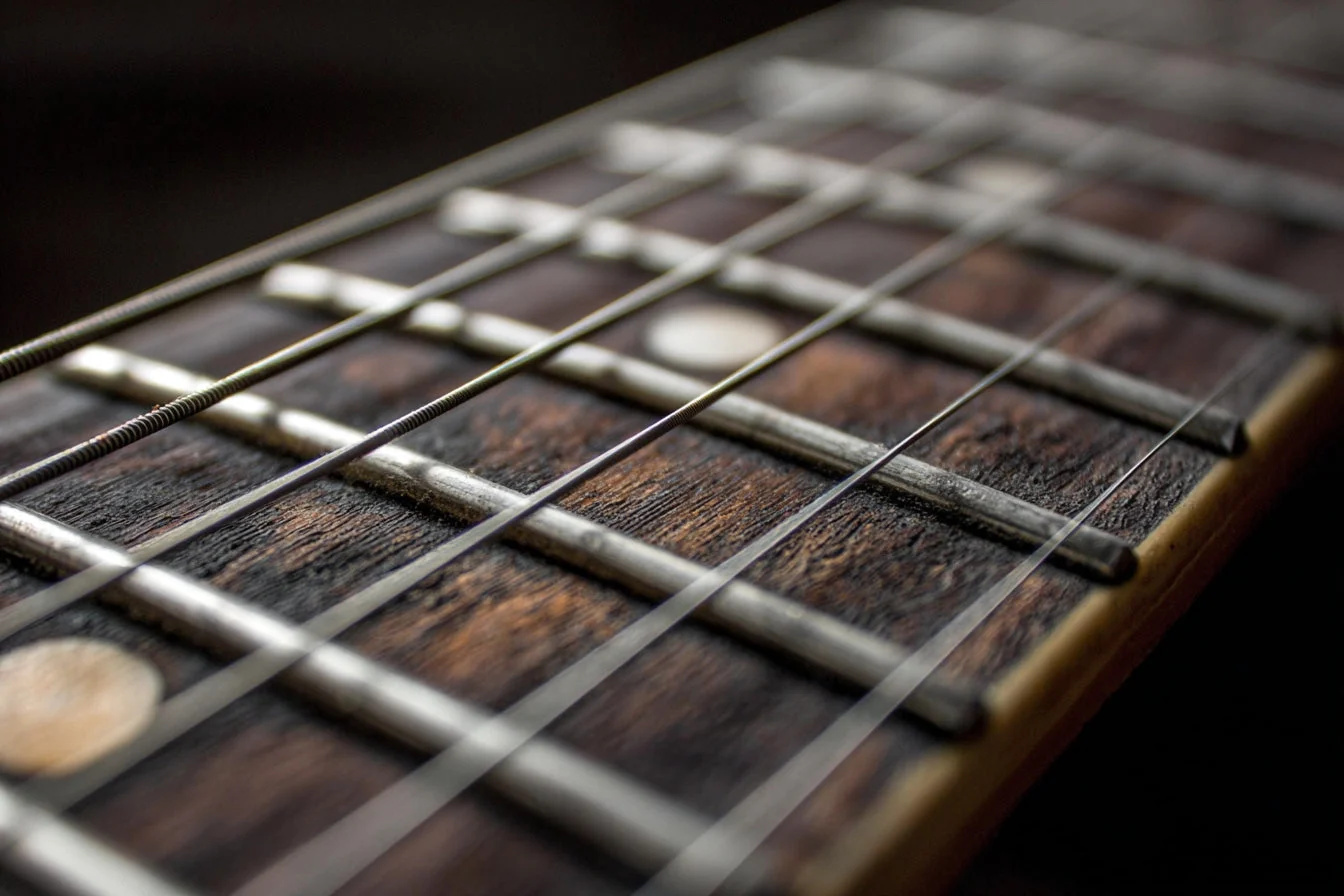
A fret is a thin metal strip set across the fretboard, the long wooden surface on the neck. When you press a string down just behind a fret, that fret becomes the new end point of the string. The vibrating part of the string gets shorter, and the pitch rises. Each fret raises the pitch by exactly one semitone, also called a half-step. Move one fret toward the body and the note goes up one half-step. Move twelve frets and the note goes up a full octave.
This system is a big reason guitar is friendly to beginners. On a violin, a finger has to land in exactly the right spot or the note sounds off. On a guitar, you only need to press somewhere behind the right fret, and the fret itself sets the pitch cleanly. The strips are usually made from a nickel-silver alloy wire. They sit in slots cut at precise points along the neck, and those points are not spaced evenly, for reasons that come down to simple math.
The Math Behind Fret Spacing and Scale Length
Fret placement follows the length of the string. Scale length is the vibrating length of the string, measured from the nut at the top of the neck to the bridge on the body. On many electrics that length sits near 25.5 inches. Every fret position is worked out as a fraction of that scale, so each semitone rings true up and down the neck.
Because each step divides what is left of the string, the gaps shrink as you move toward the body. Near the headstock, frets sit wide apart, with plenty of room for fingers. High up the neck, the frets crowd close together, and playing cleanly there takes smaller, more careful finger placement. That shrinking pattern is the same on every guitar. What changes is how many of those steps the neck has room to carry.
One fret deserves special attention. The 12th fret sits exactly at the midpoint of the string. Press there and you get the octave of the open string, the same note one full step of twelve semitones higher. Most guitars mark it with a double-dot inlay, and players use it as a landmark for finding their way around the neck. If you ever get lost mid-song, the double dots tell you where you are.
Why Classical and Acoustic Guitars Stop Earlier
On a classical guitar, the count is typically 19 frets. The neck is shorter in feel, the tradition behind the instrument is older, and the music written for it rarely calls for notes beyond that range. Nineteen frets cover the repertoire the guitar was built to play, so there was never much reason to add more.
Steel-string acoustics usually carry 20 frets. The limit here is the body itself. On most acoustics the neck joins the body around the 14th fret, and the body is a large hollow box that the fretboard can only cross so far. The last few frets sit on a short extension over the top of the body, and past about the 20th fret there is simply no useful room left. Most acoustic playing also lives in the lower and middle parts of the neck, where chords and fingerpicking patterns sit, so 20 frets serve the style well. A 12-string acoustic follows the same pattern, usually with 20 frets like a standard acoustic.
Bass guitars land in a similar range. A standard 4-string bass commonly has 20 frets, with 21 and 24 also common on some models. The job of the bass is low-end support, and its most-used notes sit well within that span.
Why Electric Guitars Run Longer
Electric guitars have a solid, slimmer body, deep cutaways, and bolt-on or set necks that let the fretboard run further over the body. That extra access is why electrics most commonly come with 21, 22, or 24 frets. The 22-fret layout is the classic standard, found on famous designs like the Stratocaster and the Les Paul. A 21-fret neck appears on some vintage-style models. A 24-fret neck is the choice on many modern instruments built for lead playing.
The range difference is real but narrow. Each extra fret adds one more high note per string. Going from 22 to 24 frets adds two extra high notes on every string, which gives a full two octaves on the high E string. For a player whose solos live at the very top of the neck, those two notes matter. For rhythm playing, blues, and most chord work, they almost never get touched.
The 22-Versus-24 Choice: Pickup Position and Reach
The most debated pair of numbers in the electric world is 22 versus 24, and the real difference is not just the two extra notes. It is where the neck pickup has to sit. To fit 24 frets, the neck runs longer into the body, so the neck pickup moves slightly toward the bridge. A pickup hears the string at the point above it, and moving it changes the sound. On a 22-fret guitar, the neck pickup sits in a spot many players describe as warm and vocal, often called a sweet spot. On a 24-fret guitar, that pickup sits a bit closer to the bridge and sounds slightly tighter and clearer in return.
Neither sound is better in any absolute sense. Classic rock and blues players often prefer the warmer neck tone of a 22-fret guitar. Metal and modern lead players often prefer the extra range and the tighter response of a 24-fret guitar. Reach plays a part too. The cutaway and neck joint on a 24-fret model are shaped to give the hand clear access to those top frets, while on some 22-fret designs the highest frets sit closer to the body joint and take a stretch to reach cleanly.
The honest rule for a buyer is simple. If your playing rarely goes past the 15th fret, the choice will not affect your music. Pick the guitar that feels right and sounds right. Fret count should be the last thing to break a tie, not the first thing on the checklist. Players who want a deeper base of setup and playing basics can start with Fender’s guitar learning and setup resources and build from there.
Fret Quality, Wear, and Why Condition Beats Count
If the number of frets says little about quality, the condition of the frets says a lot. Level, well-finished frets with smooth, rounded ends let a guitar play cleanly at every position. Rough frets with sharp ends make even a simple chord uncomfortable, and uneven frets cause buzzing on some notes and dead spots on others. A 20-fret guitar with beautifully finished frets will play better than a 24-fret guitar with rough ones, every time.
Frets also wear out slowly. Years of pressing and bending strings carve tiny divots into the wire, most often under the plain strings in the first few positions where chords get played the most. In time those dips cause buzzing and notes that choke off. A good technician can level and re-crown the frets, filing them even and rounding the tops again, and that job can usually be done a few times before the wire gets too low. Only then does a full refret, replacing the wire itself, become necessary. It is normal maintenance over a long playing life, not a defect in the guitar.
Keeping frets clean helps them last. Wipe the strings and fretboard after playing, since sweat and grime speed up wear and corrosion. It is a small habit, much like learning how to tune a guitar by ear without a tuner, and both pay off every time the guitar comes out of its case.
How to Count the Frets on Your Own Guitar
Counting takes less than a minute and needs no tools. Start at the nut, the small strip at the top of the neck by the headstock where the strings rest. Do not count the nut itself, since it is not a fret. Then count each metal strip down the fretboard, one by one, moving toward the body. The last strip, closest to the soundhole on an acoustic or the pickups on an electric, is your total.
Markers can help you keep your place while you count. The dot inlays usually sit at frets 3, 5, 7, and 9, with the double dots at 12, so you can check your count against those landmarks as you go. If you are shopping online instead, the fret count is listed in the spec sheet for nearly every model, alongside scale length, so the two numbers can be compared together.
Once you know your count, put it in perspective. Twenty to 24 frets covers the vast majority of guitars anyone will ever pick up, with travel guitars at the low end near 17 and rare extended-range instruments above 30. Your count tells you the top of your range and a little about the style your guitar was built for. It does not tell you how good the guitar is, and it should never talk you out of an instrument that feels right in your hands.