
My screen time hit 5 hours 47 minutes a day last spring. That’s 36 hours a week — nearly a full-time job of scrolling. I wasn’t even enjoying it; it was just… happening. If your phone feels less like a tool and more like a slot machine you carry everywhere, this is for you. My attempt to “spend less time on my phone” started with a shocking screen-time audit — 5 hours 47 minutes a day — and turned into a 30-day reset.
Learning to spend less time on your phone each day isn’t about willpower — it’s about design. Your phone was engineered by thousands of brilliant people to capture your attention. You, alone, with good intentions, will lose that fight. But you can change the battlefield: rearrange the phone, the environment, and the habits so the default is putting it down.
These 15 tactics are ordered from easiest to most committed. Start at the top.
Redesign the Phone (Remove the Hooks)
Start with friction: turn off all non-essential notifications. Every buzz is a slot-machine pull engineered to interrupt you — and research shows it takes 20+ minutes to fully refocus after an interruption. Keep calls, texts from real humans, and calendar alerts; kill everything else, especially news and social. Your screen time will drop 20 percent from this alone.
Next, rearrange the home screen: delete social apps (use the browser versions — clunkier on purpose), move remaining apps off the first page, and put useful tools (camera, maps, notes, e-book reader) front and center. Turn on grayscale mode — without color, apps are dramatically less appealing; studies show it cuts usage significantly. It makes your phone boring, which is the point.
Set app limits with teeth: 30 minutes for social, 20 for news, enforced by Screen Time or Digital Wellbeing with a passcode set by someone else (a partner, a friend — accountability works). Schedule Do Not Disturb for the first and last hour of the day. The Center for Humane Technology has deeper resources on reclaiming attention from extractive design.
Redesign the Environment (Phone-Free Zones)
The most powerful tactic: the phone charges outside the bedroom. Overnight. Every night. This single change kills bedtime scrolling and morning scrolling — the two most mindless sessions — and improves sleep. Get a $15 alarm clock; it’s the best $15 you’ll spend this year. Our bedroom-for-sleep guide treats this as non-negotiable for good reason.
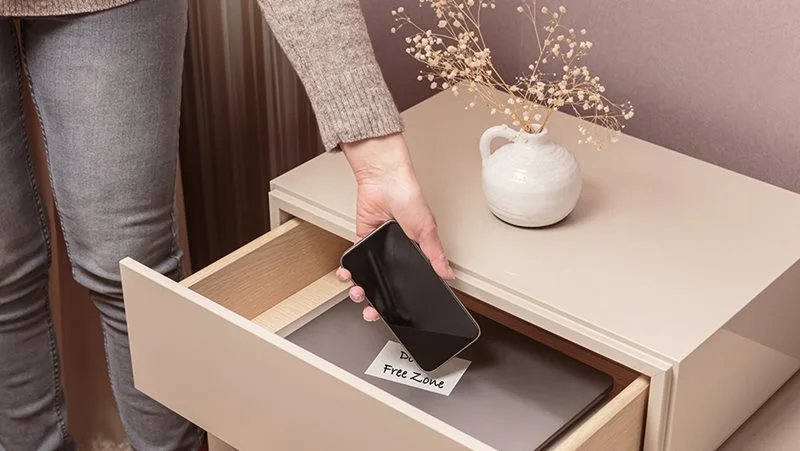
Create phone-free zones and times: meals, the first hour home, bathrooms (yes, really), and any time with other humans. Use a physical ‘phone parking spot’ — a basket by the door, a drawer in the living room. Out of sight genuinely reduces the urge; studies show even a face-down phone on the table reduces conversation quality and attention.
Replace, don’t just remove. The phone fills dead moments — waiting rooms, lines, commercials. Pre-load replacements: a book in your bag, a podcast queued, a small notebook. Nature abhors a vacuum and so does your attention; give it something better to do. Our reading habit guide turns those reclaimed minutes into books.
Redesign the Habit (Attention Training)
Try the 24-hour audit: check your screen time breakdown and categorize every hour — useful, neutral, regret. Most people find 60–80 percent is regret. That number, seen clearly, is more motivating than any lecture. Repeat monthly; watching the regret-hours shrink is its own reward.
Practice ‘single-tasking’ deliberately: when you pick up the phone, state your intention out loud (‘checking the weather’), do it, put it down. The verbal commitment breaks the autopilot slide into apps. Similarly, adopt a ‘no phone while walking’ rule — it’s safer and it reclaims hundreds of micro-moments for thinking, noticing, being bored. Boredom, it turns out, is where ideas live.
Consider periodic deeper resets: one screen-free Sunday a month, or a full digital Sabbath weekly if you’re ambitious. The first one feels strange; by the third, you’ll protect it fiercely. And tell people what you’re doing — ‘I’m cutting phone time, text me instead of DMing’ — because social accountability and adjusted expectations make the new normal stick.
Spend Less Time on My Phone: The 30-Day Reset
Here’s the reset I’d recommend: week one, just measure. Don’t change anything — just look at the numbers daily and notice. Awareness alone cuts usage; the data is confronting in a way lectures aren’t. Week two, do the environment changes: notifications off, bedroom exile, home screen rearranged. Week three, add the habit replacements: the book by the bed, the podcast for the commute, the walking rule. Week four, refine — check what’s working, adjust what’s not, and set your ongoing rules. By day 30, the phone is a tool again, not a habitat.
The metric that matters isn’t screen time — it’s the feeling. You’ll know the reset worked when you reach for the phone and find nothing to do there, when waiting rooms become thinking time again, when an evening without scrolling feels normal instead of deprived. That shift usually lands around week three, and it’s quietly profound. People report better sleep, better conversations, and the strange sensation of having more time — because they do. The hours were always there; they were just being harvested. Take them back.
15 Tactics to Cut Phone Time
- Turn off all non-human notifications
- Delete social apps; use clunky browser versions
- Move addictive apps off the home screen
- Enable grayscale mode
- Set app limits with someone else’s passcode
- Do Not Disturb for first and last hour daily
- Charge phone outside the bedroom; buy an alarm clock
- Create phone-free zones: meals, bathrooms, people-time
- Use a physical phone parking spot
- Pre-load replacements: book, podcast, notebook
- Do a 24-hour screen-time audit monthly
- State your intention aloud before picking up the phone
- No phone while walking
- One screen-free Sunday a month
- Tell people your plan for accountability
Reclaim the Hours
Do the math on your current screen time: 4 hours a day is 60 full days a year. Two months of waking life, annually, given to scrolling. Cutting it in half returns a month of life every year — for reading, for people, for hobbies, for nothing at all. Nothing at all is underrated.
Start with the bedroom exile tonight and the notification purge tomorrow. Those two alone will change your relationship with the device more than any amount of intending to ‘use it less.’
Your attention is the most valuable thing you own. Stop giving it away for free.



