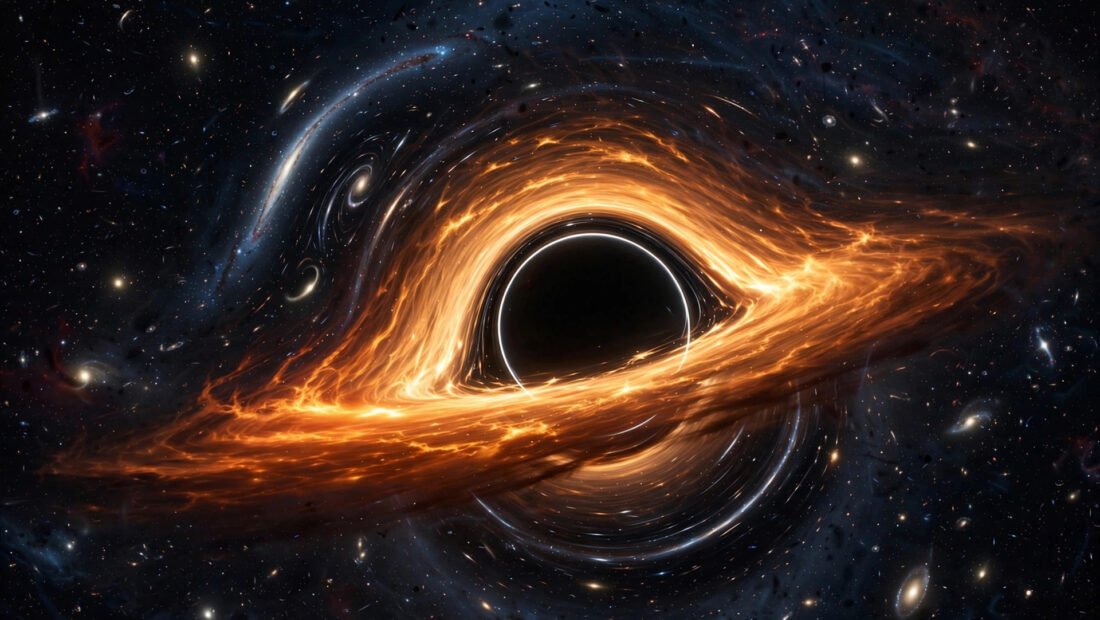
A star’s fate is written in its mass. A light star burns slowly, fades gently, and leaves a quiet ember behind. A heavy star lives fast, burns through its fuel in a rush, and ends in a collapse so complete that it can punch a hole in the normal rules of matter. Follow the heavy ones, step by step, and a black hole stops sounding like magic. It becomes the plain outcome of gravity winning a fight that fusion can no longer afford to keep fighting.
A lifelong tug-of-war inside every star
Every star is a balance held for billions of years. Gravity pulls all of its gas inward, toward the center, without pause. Fusion pushes back. Deep in the core, atoms are squeezed and heated until they fuse into heavier elements, and each fusion reaction releases energy that presses outward. As long as fuel remains, the two forces hold each other in check and the star keeps a stable size.
A massive star spends that balance at a brutal pace. Its greater weight crushes the core harder, the core runs hotter, and fusion races through its fuel far faster than it does in a smaller star like the sun. The sun can expect a life measured in billions of years. A star many times heavier may burn through the same stages in millions. Bright, hot, and short-lived is the trade that mass imposes.
The core also changes what it burns. Hydrogen fuses into helium first. When hydrogen runs low, the core contracts, heats further, and starts fusing helium into carbon and oxygen. A heavy enough star keeps going, building layer upon layer like an onion, with lighter elements fusing in outer shells and heavier elements forming toward the center. Each new fuel buys less time than the one before it. The end of the sequence is iron, and iron is where the trouble starts.
Iron, the element that ends the story
Fusing elements lighter than iron releases energy. Fusing iron does not. It absorbs energy instead. So when the core of a massive star turns to iron, the engine that held gravity back shuts off for good. There is no next fuel waiting, no reaction that can push outward hard enough to replace what was lost. The balance that lasted millions of years breaks in a moment.
What follows is collapse at a speed that is hard to picture. The iron core, roughly the mass of the sun packed into a ball about the size of Earth, falls in on itself in a matter of seconds. Temperatures and densities climb past anything in ordinary experience. Protons and electrons are forced together into neutrons. The infalling material slams into a core that suddenly refuses to compress further, and the shock of that impact tears through the star’s outer layers.
That explosion is a supernova. For a short stretch of weeks, a single dying star can outshine the galaxy that contains it, throwing its outer layers into space at enormous speed. The heavy elements built inside the star, and more forged in the violence of the blast itself, scatter outward to become part of future stars, planets, and everything built from them. What matters for black holes is the part left behind at the center, because the collapse decides its fate by weight.
The halfway house: neutron stars
If the leftover core is light enough, the collapse stops. The matter settles into a neutron star, an object with more mass than the sun squeezed into a sphere roughly the width of a city. Matter in that state is so dense that a teaspoon of it would weigh on the order of a mountain range, a comparison physicists use because ordinary language has no scale for it. The pressure of neutrons packed shoulder to shoulder holds gravity off, and the star survives in this strange, compact form.
A neutron star is not a black hole, and the difference matters. It has a surface. Light can leave it. It can spin hundreds of times per second and sweep beams of radiation across space like a lighthouse. It is extreme, but it is still a thing that can be seen and measured directly. The collapse halted one step short of the edge.
Past the limit, where the collapse does not stop
Raise the mass of the leftover core and that last defense fails. Past a threshold commonly cited at roughly three times the mass of the sun in the remaining core, no known force is strong enough to hold the collapse back. Neutron pressure gives way. The core keeps falling inward, past neutron star density, past every state of matter physics can describe with confidence.
As the mass concentrates, its gravity at its surface climbs until escape becomes impossible. Every object has an escape speed, the speed needed to break free of its pull. Earth’s is about 25,000 miles per hour. For a collapsing core, that speed rises and rises until it passes the speed of light. At that point a boundary forms called the event horizon. Inside it, escape speed exceeds light speed, and since nothing travels faster than light, nothing inside can get out. Not gas, not radiation, not a signal of any kind. Every path inside the horizon leads inward.
The event horizon is not a wall or a shell that could be touched. It is a boundary in the geometry of space itself, the surface of no return around whatever the mass has become at the center. From outside, the black hole is defined by that horizon, its mass, its spin, and very little else. Readers who enjoy pointing a telescope at deep-space targets may also enjoy how a GoTo telescope mount works and what it does for you, though no backyard scope will show a horizon directly.
How any of this is known to be real
None of this rests on theory alone. At the center of the Milky Way, astronomers have tracked individual stars for years as they whip around an invisible mass at enormous speeds, completing tight orbits in as little as sixteen years. Those orbits only make sense if millions of times the sun’s mass sits packed into a tiny volume that emits no light of its own. The stars are, in effect, test particles tracing the shape of something unseen.
Gravitational waves added a second line of proof. When two black holes spiral together and merge, the collision shakes space itself, and detectors on Earth have recorded those ripples since the first detection in 2015. Each signal matches the pattern predicted for black hole mergers, down to the final ring of the combined hole settling into shape. Dozens of such events have turned black holes from a prediction into a population that can be counted and weighed.
Then came pictures. The Event Horizon Telescope, a network of radio observatories acting as one planet-sized instrument, imaged the glowing gas ringing the shadow of the giant black hole in the galaxy M87, and later did the same for Sagittarius A*, the black hole at the center of our own galaxy. The bright ring and dark center match what physics said hot gas orbiting a horizon should look like. Background and observing details are collected at NASA’s pages on black holes and the telescopes that observe them for readers who want the primary material.
The problem nobody has solved yet
Stellar collapse explains black holes of a few to a few dozen solar masses, and mergers can grow them larger over time. The giants are harder. Most large galaxies hold a supermassive black hole at the center, millions or billions of times the sun’s mass, and telescopes now find such giants sitting in galaxies that formed very early in the history of the universe. That timing is the puzzle. A black hole feeding at realistic rates, or growing through mergers alone, struggles to reach billions of solar masses in the time available.
Several ideas compete to close the gap. Perhaps some black holes began as unusually heavy seeds, formed from the direct collapse of huge gas clouds rather than from single stars. Perhaps early black holes fed faster than the usual limits for stretches of time, hidden inside thick clouds of gas. Perhaps mergers in crowded young galaxies ran far more often than they do now. Each idea explains part of the evidence and strains against another part, and the honest state of the science is that the growth story of the largest black holes is still being written.
Gravity at a distance is still just gravity
Movies treat black holes as cosmic vacuum cleaners that reach across space and drag everything in. Physics says otherwise. At a distance, a black hole pulls exactly as hard as any other object of the same mass. Gas, dust, and stars fall in only when their paths carry them close, the same way a comet falls toward the sun only when its orbit brings it near. Far away, orbits behave in the ordinary way, which is why stars can circle the Milky Way’s central black hole for lifetimes without being swallowed.
The nearest known black hole sits well over a thousand light-years away, far beyond any reach that matters. A simple thought experiment settles the threat question. Replace the sun with a black hole of exactly the same mass, and Earth’s orbit would not change. The planets would keep their paths, held by the same gravity at the same distance. Life would end from cold and darkness, not from being pulled in. Black holes are extreme up close and unremarkable from far away, and distance is what Texas, and everywhere else on Earth, has in abundance.