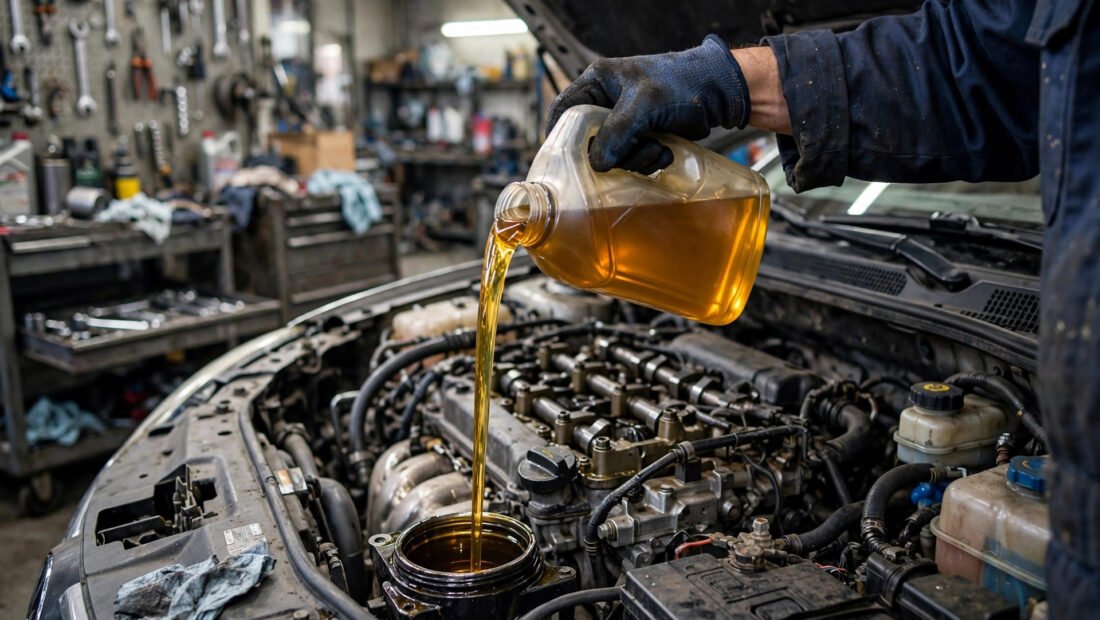
The board at the quick-lube shop makes it look simple. Conventional oil, about $40. Full synthetic, about $80. Twice the price, so it must be a upsell, right? Not quite. Once you divide that price by how many miles each oil can actually cover in Texas heat, the math flips. The expensive bottle stops looking expensive, and the cheap bottle stops looking like a bargain.
Conventional at $40 to $50 every 4,000 miles comes out near 1.1 cents a mile. Full synthetic at $70 to $90 every 8,000 miles comes out near 1.0 cents a mile. That is the comparison that matters — not the sticker, but the cost to stay protected for a year of driving. Texas adds a second part, too. Heat wears oil out. A 105-degree afternoon in Houston traffic, a long idle with the air conditioning running, a tow across the Hill Country in August — all of that punishes oil. You are comparing two fluids, two lifespans, and two levels of forgiveness when you run late.
What Each Oil Actually Is
Conventional oil starts as refined crude, blended with additives that keep the engine clean, fight corrosion, and hold the right thickness as temperatures change. The catch is the base itself. Because it comes from a natural source, its molecules come in many sizes and shapes. Some hold up well under heat. Some break down sooner.
Full synthetic oil is built in a different way. Its base stocks are engineered molecule by molecule, so the molecules are far more uniform. That uniformity is not a marketing detail. It is why synthetic flows quickly on a cold start, holds its thickness when the engine is hot, and resists breaking down over a long interval. The additive package is usually stronger, too, with better detergents and better protection against oxidation, which is the chemical process that turns fresh oil dark, thick, and less able to protect metal parts.
Between the two sits the synthetic blend, a mix of both base oils. You get part of the benefit for part of the price bump. It will not match a full synthetic on heat resistance or interval length, but it is a reasonable middle choice for a tight budget.
How Texas Heat Changes the Comparison
Heat is the main reason this choice matters more in Texas than it does in a cooler state. Under the hood on a summer day, oil faces far higher temperatures than the weather report suggests. Sitting in stop-and-go traffic means less airflow, more heat soak, and an engine working hard just to run the compressor and keep the cabin bearable. Over weeks and months, that heat speeds up oxidation in conventional oil. The oil thickens, forms varnish, and in neglected cases turns toward sludge, the thick deposits that clog narrow oil passages and starve parts of lubrication.
Synthetic handles that stress with more room to spare. It still gets dirty and still needs changing, but it degrades more slowly — exactly what you want when summer lasts half the year. Turbocharged engines make the point sharper. A turbo runs extremely hot, and oil left near it after shutdown can cook into hard carbon deposits, a problem called coking. Most turbo makers now require full synthetic for that reason. If your manual calls for synthetic, treat anything else as a warranty risk as well as a mechanical one.
Honest Intervals for Each Oil
Price per mile only works if the intervals are honest. For conventional oil in Texas heat, 3,000 to 5,000 miles is the sensible range for most cars, with the lower end making more sense if you tow, idle a lot, drive mostly short trips, or spend your commute crawling. Short trips are hard on oil in a different way. The engine does not stay hot long enough to burn off moisture and fuel that collect in the oil, so the oil gets contaminated faster even though the odometer moves slowly.
For full synthetic, 7,500 to 10,000 miles is the range many manuals allow under normal use. You visit the shop half as often, which is a big part of its value. Most manuals also list a shorter severe-service schedule. Read it carefully — many Texas drivers meet its conditions without realizing it, especially frequent idling, dusty roads, and repeated short drives. Time matters, too: even a low-mileage car needs fresh oil at least once a year. If you are unsure which schedule fits you, the U.S. Department of Energy’s guidance on engine oil and vehicle maintenance is a calm place to start, and your manual is the final word.
Reading the Bottle Without Getting Lost
The labels look crowded, but only a few items decide whether an oil is right for your car. The first is viscosity, written like 0W-20 or 5W-30. The number before the W describes how the oil flows when cold. The number after describes its thickness at operating temperature. Modern engines are built around tight tolerances and systems like variable valve timing that depend on oil arriving at the right thickness at the right moment. Putting in a thicker oil because summer feels hot is a mistake. The engineers who designed the engine already accounted for heat. Match the grade in the manual.
The second item is certification. Look for the current American Petroleum Institute standard and any maker-specific approval your car needs. General Motors, for example, uses its dexos specification. Those are not upsells. Using oil that misses a required specification can create a real problem if you ever need warranty coverage for an engine failure. The shop should be able to show you the bottle or the bulk-oil spec without hesitation. If they cannot, go somewhere else. When you compare prices, ask for the out-the-door price including filter and disposal, so you are comparing the same job.
When Conventional Still Makes Sense
A fair comparison has to admit the cases where conventional wins, or at least ties. An older, non-turbo engine that the manual says can run on conventional, driven gently and changed on time every time, will live a long and healthy life on conventional oil. There is no prize for buying a premium fluid and then stretching it carelessly, just as there is no shame in buying the basic fluid and changing it with discipline.
Conventional can also make sense for a car you plan to sell soon, or a low-value work vehicle where the next owner will set their own routine. The key condition is honesty about the interval. Conventional only works when the short interval is real. If you know your schedule is chaotic, if you routinely go months past due, or if the car spends its life in brutal heat and traffic, the forgiveness of synthetic is worth paying for. The fluid that protects you when you are late is often the cheaper choice in the end.
The same care that leads a driver to learn how to park on a hill without damaging your transmission shows up in oil changes, too. Engines rarely die from one dramatic error. They wear out from a long run of small neglect.
High-Mileage Formulas and Older Engines
Once an engine passes about 75,000 miles, you will see high-mileage versions of both conventional and synthetic oils on the shelf. These add seal conditioners that help aging seals stay soft and swell slightly, plus extra detergents for engines that have built up deposits over the years. In Texas, where heat hardens rubber faster, that seal help is not trivial. A faint weep around a valve cover or a small spot on the driveway is often the first sign that seals are drying out.
A high-mileage synthetic is a sensible pick for an aging daily driver you plan to keep. It will not repair worn bearings or reverse years of missed changes. What it can do is slow small leaks and keep things cleaner. If oil use between changes climbs fast, or you see blue smoke, treat that as a mechanical problem to diagnose, not an oil problem to mask.
Doing It Yourself Versus Paying a Shop
Changing oil yourself typically saves $30 to $50 over a shop visit, once you own a drain pan, a filter wrench, and a safe way to lift the car. You also get to choose the exact oil and filter, and you know the drain plug was handled with care. The tradeoffs are time, mess, and disposal. In Texas, most auto parts stores take used oil for free, which removes the worst excuse for bad disposal. Never pour used oil on the ground or into a drain. One careless dump contaminates a huge amount of water.
A shop buys you speed, a record, and a second set of eyes. Good shops check belts, hoses, and fluid levels on the lift, and their records help at resale and with warranty questions. The risk is the upsell at the counter. Know your manual’s intervals before you arrive, and decline anything you do not understand until you can check it. Whichever route you choose, write down the date, mileage, oil grade, and brand. That simple record is how you prove the car was cared for if a problem appears at 140,000 miles.
The Recommendation
For most Texas drivers with a modern car they plan to keep, full synthetic is the better buy. It costs about the same per mile as conventional once you count the longer interval, it protects better in the heat that defines driving here, it keeps the engine cleaner over high mileage, and it forgives the occasional late change instead of punishing it. If your manual requires synthetic, or your engine has a turbo, treat that recommendation as a requirement and do not bargain with it.
Choose conventional with confidence only when the fit is clear: an older, simple engine, a manual that allows it, and an owner who truly changes it every 3,000 to 5,000 miles without fail. Choose a blend when budget is tight and you want a modest step up, but keep its interval closer to conventional than to full synthetic.
Above all, do not let the choice of oil become an excuse to stretch the interval. The enemy is not conventional oil. The enemy is neglected oil — old, oxidized, sludge-forming oil left in the engine long past its useful life, on its way to a repair bill near $6,000 for a replacement engine. Pick the fluid that matches your car and your real habits, change it on time, and keep the receipt. That habit, repeated for years, is what lets a Texas engine reach 200,000 miles without drama.