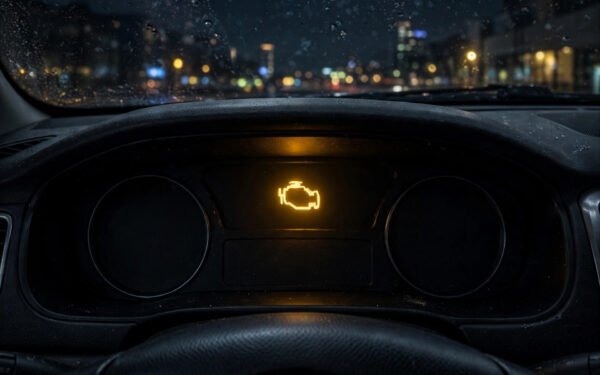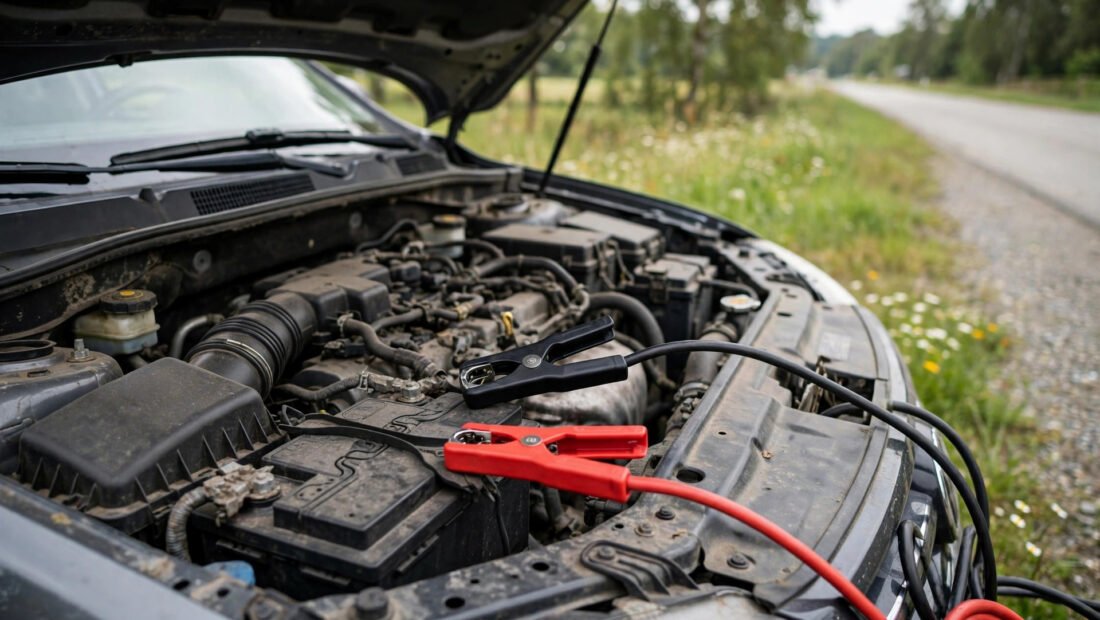
A dead battery never picks a good moment. It quits in a dark grocery lot after the last run for milk, in an office garage on the fifth level, or on a shoulder somewhere between towns where the next exit is ten miles back. The good news is that getting the car going again is not hard. The risk is not the job itself. The risk is doing the connections in the wrong order, in the dark, in a hurry, with a spark landing in the wrong place. Work through the gear first, then the steps in the exact order below, and the whole thing becomes calm and routine, even on your own.
What to carry so you are never stuck waiting
Start with jumper cables worth owning. Look for a set about 20 feet long and rated 4-gauge or 6-gauge. Length matters more than most people expect. A short set forces the two cars to sit almost touching, which makes positioning awkward and sometimes impossible if the dead car is nosed into a space. Thick cable matters too. A truck or a large SUV needs real current to turn over, and thin bargain cable can get warm, lose voltage, and fail to start a big engine even when the donor battery is strong. Copper or copper-clad cable with solid, wide-opening clamps is the right buy. Store the set in a bag so the clamps do not tangle or corrode loose in the trunk.
The second option has quietly changed the job. A portable lithium jump pack, typically about $60 to $120, holds enough charge to start most cars several times and fits in a glove box or under a seat. With a pack there is no donor car, no flagging down a stranger, and no worry about whether another driver will stop at midnight. Keep it charged. Check it every few months, top it up after any use, and bring it indoors during a hard freeze if the maker advises it. For drivers who cover long Texas distances, where help can be far away, a charged pack is close to the best $80 you can spend on your car.
Add two small things. Gloves protect your hands from sharp metal and from battery grime. Eye protection is cheap insurance, because batteries contain sulfuric acid and can vent hydrogen gas. You will probably never need either one. Wear them anyway. Finally, keep the owner’s manual in the car or saved on your phone. Many newer cars use a jump point under the hood that is not the battery itself, especially when the battery sits in the trunk or under a seat. The manual names the correct points, and guessing on an unfamiliar car is how terminals get damaged.
Before the first clamp: setup and safety checks
If a second car is helping, park it nose to nose or side by side with the dead car, close enough for the cables to reach with slack to spare. The two vehicles must not touch each other. Metal-to-metal contact between the bodies can create an unwanted electrical path. Set both parking brakes. Put automatics in Park and manuals in neutral.
Turn everything off in both cars. Headlights, cabin lights, radio, air conditioning, heated seats, phone chargers — all of it off, and both ignitions off. Anything left drawing power steals current from the start and can spike sensitive electronics when the circuit connects. Take the keys out if your car still uses a physical key, or keep the fob away from the start button until you are ready.
Look at the dead battery before you touch a clamp. If the case is cracked, swollen, leaking, or smells strongly of rotten eggs, do not jump it. A damaged battery needs replacement and professional handling, not a boost. If the terminals are buried under white or green crust, brush or wipe the worst of it away so the clamps can bite clean metal. A poor connection at a dirty terminal is a common reason a correct procedure still fails.
The jump-start steps, in the one safe order
- Red clamp to the dead battery’s positive terminal. Open the red cover if there is one, confirm the plus sign, and clamp firmly on the terminal post itself, not on a loose cable end.
- Red clamp to the donor battery’s positive terminal. Same care, same firm bite. The red cable now links the two positive terminals, but the circuit is not complete yet, so there should be no spark.
- Black clamp to the donor battery’s negative terminal. Confirm the minus sign and clamp it on.
- Last black clamp to bare metal on the dead car, away from the battery. Choose an unpainted bolt or bracket on the engine block or a strut tower bolt, at least 18 inches from the battery. Never put this last clamp on the dead battery’s negative terminal. The final connection can make a small spark, and a battery can vent flammable hydrogen. Keeping that spark well away from the battery is the whole point of this step.
- Start the donor car and let it idle for 2 to 3 minutes. A short idle lets some charge flow into the dead battery and makes the next step far more likely to work on the first try. Resist the urge to rev the engine hard; a steady idle is enough.
- Start the dead car. Turn the key or press the button and crank for no more than about 10 seconds. If it does not catch, stop. Wait a full minute, let the donor keep idling, and try once more. Long, repeated cranking overheats the starter and drains what little charge you have built up.
- Remove the clamps in exact reverse order. Ground black off the dead car first, then donor black, then donor red, then dead red. Keep each clamp from touching metal or another clamp as you set it down. Letting loose clamps dangle against bodywork is how a successful start ends with a short.
- Drive the revived car for 20 to 30 minutes. Steady driving, ideally at highway speed, lets the alternator put real charge back into the battery. Idling in the lot for five minutes and switching off again often leaves you right back where you started.
With a jump pack the sequence shrinks. Connect red to positive, connect black to a ground point away from the battery, switch the pack on, start the car, then switch the pack off and remove black first, red second. Follow the pack maker’s order if it differs slightly, and never leave a pack connected and running the car longer than directed.
The same patience that fixes a car battery explains a smaller version of the problem too. If a morning starts with two dead devices instead of one, the habits behind why your phone battery drains overnight and how to stop it are worth a look once the car is safely home.
Modern cars: AGM, start-stop, and battery sensors
Many newer vehicles use an AGM battery, short for absorbent glass mat, to support start-stop systems that shut the engine off at lights. These batteries jump-start the same way as a standard battery. The difference shows up afterward. An AGM battery wants a charger designed for it when it needs a full recharge off the car. A basic charger set wrong can shorten its life. If your car shuts itself off at every red light, assume the battery is AGM until you confirm otherwise.
Battery management systems add a second wrinkle. Many late-model cars track charge through a small sensor on the negative terminal. Grounding your last clamp to the chassis or engine block, rather than directly to that terminal, routes current the way the sensor expects and keeps its readings honest. That is one more reason the ground-point step is correct practice, not old habit.
Hybrids and fully electric cars still carry a small 12-volt battery that runs the computers, locks, and lights. When that battery dies, the car can seem completely dead even though the large drive battery is fine. You jump the 12-volt battery, using the jump points the manual lists, because on many models the battery itself is tucked in the trunk or under trim. Do not improvise connection points on a hybrid. Use the marked terminals, keep the current modest, and never try to jump another car from a hybrid or EV unless the maker explicitly allows it.
Why Texas heat eats batteries
Cold gets the blame for dead batteries, but in Texas heat does the quiet damage. A typical car battery lasts about 3 to 5 years nationally. In South and Central Texas, 2 to 3 years is common. Sustained heat speeds up the chemical wear inside the battery, drives off electrolyte, and corrodes terminals faster. Under-hood temperatures in a sun-baked lot can pass 170 degrees, and the battery sits in that oven every afternoon, all summer long. The failure then shows up on the first cool morning, which is why so many drivers swear the cold killed a battery that the summer had already finished.
Simple defenses stretch that life. Park in shade or a garage when you can. Keep terminals clean and tight, and treat early corrosion before it insulates the connection. A wire brush and a small tube of terminal protector cost very little. Most of all, replace the battery on a schedule instead of on a tow truck’s timetable. In a hot part of the state, testing at two years and planning replacement around three years beats learning the lesson at midnight. For the official safety guidance behind these steps, see AAA’s guidance on jump-starting a car and battery service.
If the car still will not start
A click with no crank usually points to a poor clamp connection or a battery too far gone to accept help. A rapid clicking often means the charge is still too low — give the donor more idle time and check every clamp. A slow crank that never catches can point past the battery, toward the starter or fuel delivery. At that stage, stop repeating the attempt. Call roadside help, get the battery tested at a parts store, and replace what tests bad. A jump gets you moving. It does not repair a battery that has reached the end of its life, and driving on a failing battery risks a second stranding in a worse place than the first.