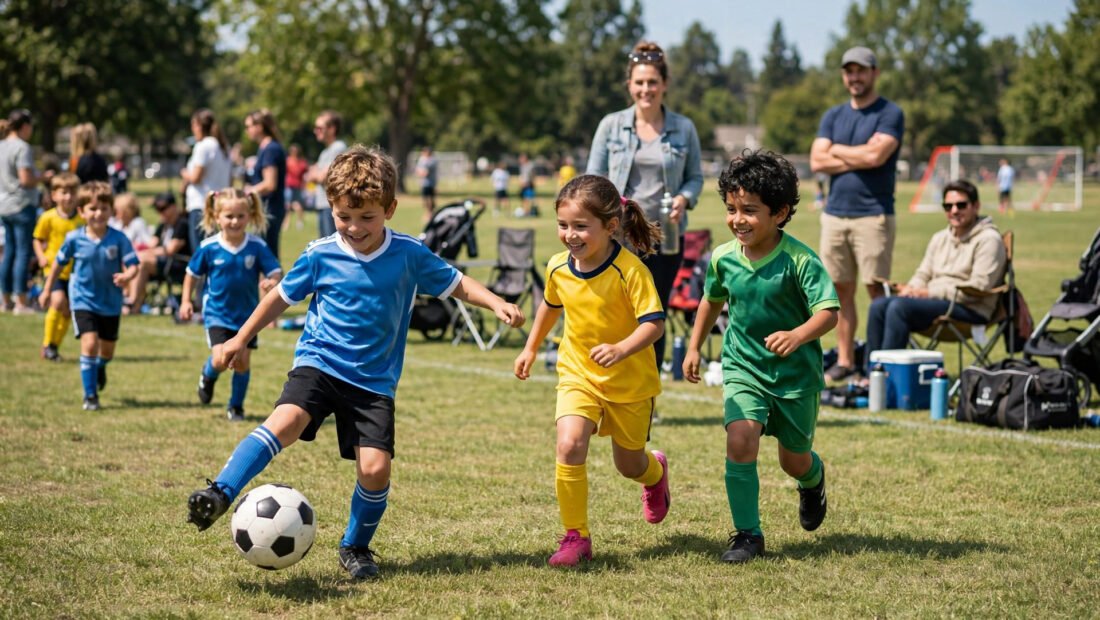
On a Saturday morning in Texas, a five-year-old in an oversized jersey runs hard after the ball, connects with a happy kick, and then stops completely. A butterfly has crossed the field. The ball rolls on without her. Half the parents on the sideline laugh. Her own parent laughs too, and then asks the question quietly, the one that brought the family here in the first place: is she actually getting anything out of this at five, or did we sign up a year or two too soon?
Follow one season of that kind of team, the youngest recreational kind, and the answer becomes clearer than any age chart makes it. The season shows what five-year-olds can absorb, what they cannot yet, and why the best starting age depends on the child in front of you far more than on the neighbors’ plans.
September: What the First Practices Really Look Like
The first practice is mostly not soccer. In a good under-six program, the games are three against three or four against four, with no goalkeeper, no scores kept, and every child playing equal time. Sessions run on simple, short activities: dribble toward a cone, freeze when the whistle blows, kick the ball into a wide goal and run back grinning. A coach who knows this age group changes the game every few minutes, because attention at five is measured in minutes.
Our butterfly chaser fits right in. She can run, kick, and balance well enough for this level, and those basic movement skills are the real curriculum at four to six. She cannot yet follow a position, remember a multi-step drill, or pass on purpose to a teammate she has picked out. Nobody on the field can, reliably. That is not a failure of coaching. It is where development sits at this age, and a program built for it feels like play with a ball at its center, which is exactly the point.
Parents watching the first weeks often judge by the wrong measure. Goals tell you almost nothing here. Look instead at whether your child runs back for more after a fall, waits for a turn without melting down, and listens to a coach who is not you for stretches of thirty to forty-five minutes. Those are the readiness signs that matter: following simple rules, taking turns, separating from you without distress, handling mild frustration, and, above all, wanting to be there.
October: The Case for Starting at Four to Six
By mid-season, small things have compounded. The child who chased the butterfly now dribbles two or three touches before kicking. She knows which goal her team attacks, most weeks. She has a teammate whose name she shouts in the car. None of this is advanced soccer. All of it is the foundation later soccer is built on: comfort with the ball at her feet, ease inside a group, and the sense that Saturday morning is hers.
This is why ages four to six are the sweet spot for starting, as long as starting means recreational play. The cost stays low, often under $150 a season in city-run or YMCA programs, sometimes $100 to $200 per season including a uniform. The commitment stays low too: one practice and one game a week, with volunteer coaches. If the season ends and your child is lukewarm, you have spent a modest fee to learn something useful, and no harm is done. Backyard kicking would have been fine as well. At three and even four, unstructured play with a ball teaches a great deal, and a league adds structure a child may or may not want yet.
The Texas details shape the season. Youth leagues sensibly put the youngest games in the morning, because children overheat faster than adults. Even so, a parent pack list matters: water before, during, and after the game, a hat and shade on the sideline, and sunscreen. A light snack one to two hours before play, such as a banana, toast, or a granola bar, is enough fuel. Sports drinks are unnecessary for hour-long games at this level. Water does the job. Sleep belongs on that list too, even at five. A child who is up late the night before a morning game melts down faster, listens less, and enjoys less, and no amount of sideline encouragement makes up for a tired body.
November: What the Season Cannot Do, and Why That Is Fine
Near the end of the season, a familiar pressure shows up on sidelines. Another parent mentions an academy program, or a select club with tryouts, and wonders aloud about getting serious early. The season you have just watched is the best answer to that idea. A five-year-old who still loses the plot when a butterfly crosses has gained everything this level can give. Adding year-round training, private sessions, and travel at seven or eight would not add development at the same rate. It would mostly add cost, schedule strain, and injury and burnout risk.
The distinction that matters is starting young versus specializing young. Guidance for young athletes consistently warns against single-sport, year-round specialization before about age fourteen. Young bodies doing the same motions all year pick up more overuse injuries, and young minds doing one sport under pressure quit at higher rates. Many top players, when their histories are examined, played several sports through early adolescence. The child who plays soccer in the fall, tries swimming or basketball in the winter, and rides a bike all summer is not falling behind. She is building broader movement skills that tend to make a better soccer player by high school, if she still wants to be one.
The parent’s job through all of this is narrower than it feels. Cheer effort, not results. Leave coaching to the coach, since sideline instructions that clash with the coach embarrass a child and confuse her in the same moment. Keep the car ride home free of a performance review. Ask whether she had fun, and let the answer stand. Pressure and lost fun are the main reasons children leave sports, and both usually arrive from the adults who love them most.
Families building healthy weekend habits around games will also want a plan for how to avoid injuries in weekend soccer games as children grow older, stronger, and faster, because the risks at eleven are not the risks at five.
The Older Doors: Seven to Nine, and Ten to Twelve
Suppose the butterfly season never happened. Suppose your child first asks about soccer at eight, or eleven. The worry that it is too late is common, and the season’s logic answers it. Ages seven to nine are often called the golden window for skill learning, and for good reason. Children in that range can follow instructions with several steps, start to grasp positions and teamwork, and their bodies are primed to pick up movement patterns quickly. A child who starts at eight with decent coaching can catch and pass a child who started at four and trained casually. The head start from the youngest leagues is real but small, because so much of it was general coordination that an active eight-year-old already has.
Starting at ten to twelve is still completely workable, especially for a child who is athletic from other sports. Older beginners often learn the thinking side faster and progress quickly once the basic touches settle. The main risk is social, not physical: walking into a team where most players have years of shared habits can feel exposing. The fix is choosing the right door. A recreational or developmental league welcomes a late starter. A tryout-based select team, with costs that can run $2,000 to $5,000 or more a year in Texas metros plus heavy travel, is the wrong first step for almost any beginner, whatever their age.
Between those levels sits the academy or developmental tier for roughly ages seven to ten, with trained coaches and a bit more commitment, at costs often around $500 to $1,500 a year. It suits a child who has finished a recreational season or two asking for more. National pathways with names like ECNL and MLS Next sit far above all of this and concern a tiny share of teenage players. If your child ever belongs in that conversation, the signs will be obvious long before you need to research it.
The Decision, Back on That Sideline
Return to the five-year-old and her butterfly. By the last game, she still watches insects. She also dribbles with her head up for a few steps, defends the right goal without being told, and runs to her coach first when the final whistle goes. Signing up at five helped, because what she was signed up for matched what five can do: short games, equal time, low cost, and play that happened to use a soccer ball.
That match is the whole answer. Start at four to six if your child shows the readiness signs and the program is recreational and fun-first. Wait without worry if your child would rather kick a ball in the yard, because seven to nine is a superb window and even ten to twelve leaves the door wide open. Hold off on year-round, single-sport commitment until the teenage years, whatever the starting age. For schedules, age groups, and parent education in one place, US Youth Soccer’s parent and player resources are a solid next stop.
The best age, in the end, is the age at which your child asks to go back next week. Protect that feeling, keep the level matched to the child, and the starting date takes care of itself.