Two honest judges reach different verdicts on the same Texas commute. The spreadsheet counts gallons, kilowatt-hours, oil changes that never happen, and a purchase premium that takes years to earn back — and its answer changes completely depending on how many miles you drive. The morning commute counts something else: silence at 6 a.m., instant pull away from a light, and a car that is full every dawn without a gas station stop all week. Weigh both judges fairly, with the same car and the same roads, because a verdict built on only one of them will steer the wrong buyers in both directions.
The case for: the fuel math is not close
Start with a typical Texas commuter car. At 30 miles per gallon over 15,000 miles a year, it burns about 500 gallons. At roughly $3 a gallon — a reasonable planning figure for Texas — that is about $1,500 a year in fuel. The electric equivalent uses electricity at home, where Texas residential rates commonly run about 13 to 16 cents per kilowatt-hour. The same 15,000 miles cost roughly $585 to $720 a year on home charging. Fuel savings land around $800 to $900 a year for that average driver, and the gap widens fast for anyone driving a thirstier vehicle. Overnight and off-peak plans widen it further; some Texas plans dip under 10 cents per kilowatt-hour at night, which is when a commuter car is parked at home anyway.
Miles multiply everything. A 25,000-mile-a-year super-commuter — unremarkable in Houston, Dallas–Fort Worth, or Austin sprawl — saves roughly $1,300 to $1,800 a year on fuel alone. That driver is also the person spending the most life at gas stations, which is why the fuel figure understates the change for them.
Maintenance adds the quieter half of the case. An electric car has no oil changes, no spark plugs, no exhaust system, no transmission fluid service in the usual sense, and its brake pads last far longer because the motor does much of the slowing. Industry estimates commonly put EV maintenance at roughly half the cost of a comparable gasoline car, saving a typical driver about $400 to $600 a year. Add fuel and maintenance together and a Texas commuter saves roughly $1,200 to $2,400 a year, every year of ownership. That is the strongest honest number on the “for” side, and it recurs — it is not a one-time rebate doing the work.
The case for: the commute itself feels better
Numbers do not capture the daily texture, and daily texture is the product a commuter actually buys. An electric motor delivers its push instantly, so merging onto a 70-mile-per-hour Texas freeway from a short ramp is calm instead of frantic. One-pedal driving, where lifting off the accelerator slows the car smoothly, turns stop-and-go traffic from a brake-tap workout into something closer to gliding. The cabin is quiet. There is no idle vibration at lights.
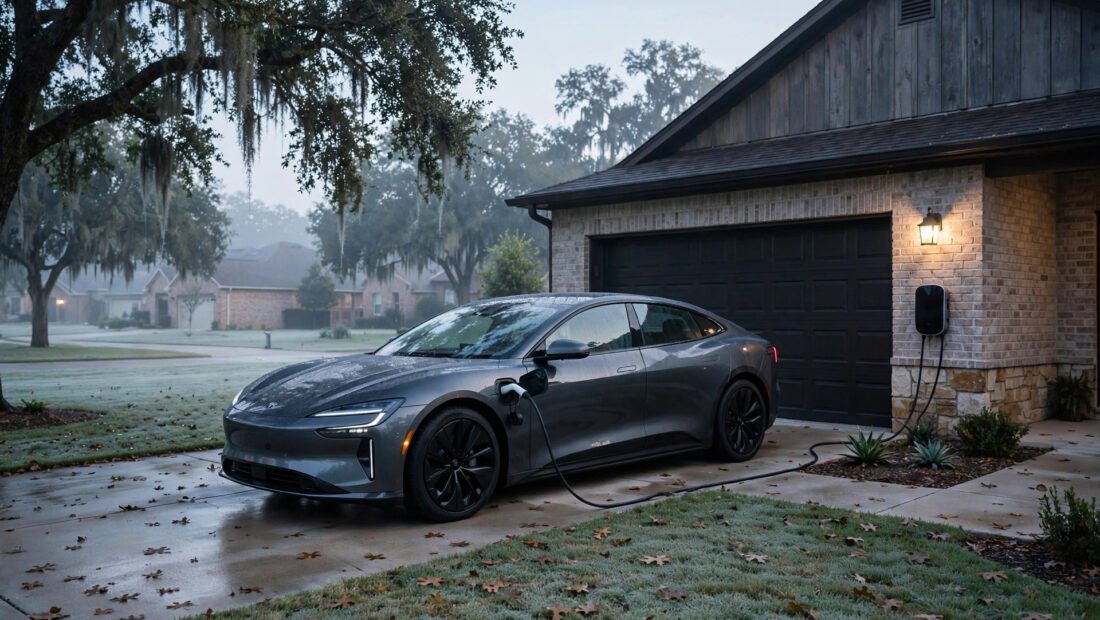
Home charging rewrites the weekly routine. You leave each morning with a full “tank” that cost a few dollars of overnight electricity, and the gas station simply exits your life except on road trips. For a two-car household, that convenience compounds: the electric car tends to become the default choice for every errand, which pushes its miles up and its per-mile savings along with them. Handling electricity costs at home is its own small skill — anyone who has tallied how much electricity a gaming PC uses per month already thinks in the kilowatt-hours that make EV running costs easy to predict.
The case against: the premium takes years to earn back
Now the other spreadsheet column. Comparable electric cars still typically cost about $5,000 to $10,000 more upfront than their gasoline equivalents, even though the gap narrows each year. Divide that premium by the annual savings and the break-even point lands at roughly 4 to 7 years for an average commuter, and about 3 to 5 years for a high-mileage driver. Keep a car eight or ten years, as many Texans do, and the electric side wins comfortably. Trade every two or three years, and you may sell the car before it has paid you back.
One factor can move that line a lot, and it must be stated carefully. A federal tax credit of up to $7,500 exists for qualifying new electric vehicles. Eligibility rules — income limits, where the vehicle and its battery are made, price caps — are narrow and change, so treat the credit as up to $7,500 and verify the specific vehicle qualifies before counting a cent of it. A qualifying car bought with the full credit can pull break-even forward by years. A non-qualifying car gets nothing, and a budget built on an assumed credit that never arrives is a budget built on air.
Depreciation cuts both ways and deserves an honest line. Electric resale values have swung more than gasoline values as prices, incentives, and battery news shift. That volatility is a real risk for short-term owners and a real opportunity for used buyers, who increasingly find the fuel math working in their favor at a much lower entry price.
The case against: Texas realities — heat, distance, and the grid
Heat first. Lithium batteries age faster in sustained high temperatures, and Texas delivers them. The fear version of this story — batteries dying in three summers — does not match the data. Well-managed modern packs in hot climates commonly retain roughly 85 to 90 percent of capacity at 100,000 miles: a real loss, not a fatal one. Every current electric car has active thermal management that protects the pack, and it works best while the car is plugged in. Owner habits help further: park in shade or a garage, charge to about 80 or 90 percent for daily use instead of sitting at 100, and schedule charging to finish near departure time.
Distance next. Modern electric cars commonly offer 250 to 350 miles of rated range. Texas highway reality — 75 to 80 miles per hour with the air conditioning working hard — trims that by roughly 15 to 25 percent. For the large majority of commuters driving under 100 miles a day, even a heat-aged battery covers the round trip with room to spare, twice over. Road trips across the state are doable along the major corridors, where fast charging now lines the interstates, but they still ask for planned stops that a gasoline car does not.
Then the grid question every Texan asks: ERCOT. The short honest answer is that a commuter car charging overnight draws modest power at the grid’s emptiest hours, and managed charging programs increasingly reward exactly that timing. A car charging at noon on the hottest August afternoon is a different story, which is one more reason the overnight habit matters — for the bill and for the grid alike. Compare any model’s official ratings before buying using the official U.S. fuel economy and electric vehicle cost comparisons at FuelEconomy.gov, and run the numbers at your own electric rate, not a national average.
The access question that quietly decides everything
Strip away every other argument and one fact dominates the verdict: where the car sleeps. Home charging delivers the low rates, the full-every-morning convenience, and the battery-friendly overnight pattern. Workplace charging, expanding across Texas metros and sometimes free as an employee perk, is a strong substitute — ask before assuming your employer offers nothing. Apartment living is the hard case. Some newer Texas complexes advertise chargers; many older ones have none, and rules on installing your own vary by lease, landlord, and homeowners association. Relying on public fast charging as your main plan typically costs two to four times home rates and adds a standing appointment to your week. It works for a few tidy routines. For most drivers it erodes both the savings and the joy that justified the car.
Two smaller costs deserve a place in an honest tally, because both sides tend to skip the one that hurts their argument. Electric cars are heavy and deliver strong pull from a stop, so tires can wear faster than on a comparable gasoline car, especially if every freeway merge becomes a test of that instant response; driven calmly, the gap shrinks a lot. Insurance quotes also vary more between models and insurers for electric cars than many buyers expect, so a quote belongs in the budget before the purchase, not after it. On the other side of the ledger, there is no state inspection line for emissions equipment that does not exist, no belts and hoses aging the same way under the hood, and brake work arrives rarely enough that many owners meet it once in a long ownership. None of these items overturns the fuel and maintenance math. Together they explain why two neighbors with similar cars can report honestly different savings: driving style, tire choice, and an insurance quote move the real total by hundreds of dollars a year in either direction.
The verdict
For the Texas commuter with home charging who drives average miles or more and keeps cars a while, the electric car wins on both judges: roughly $1,200 to $2,400 a year back in fuel and maintenance, break-even in about 3 to 7 years depending on mileage and any verified credit, and a calmer drive every single morning. Buy one with your eyes open about heat habits and real highway range, and it should serve a decade of commutes well.
Three profiles should honestly wait. Drivers with no home or workplace charging, whose savings shrink to public-charging prices. Low-mileage drivers — under roughly 8,000 miles a year — whose fuel savings cannot pay back the premium in a sensible time; for them a cheap, sound used gasoline car, even around $12,000, still beats a $30,000 electric car on pure economics. And short-term owners who will sell in two years, before the math turns. Everyone else sitting in Texas traffic at dawn, watching the fuel gauge and doing quiet arithmetic, is exactly the driver the numbers — and the mornings — now favor.