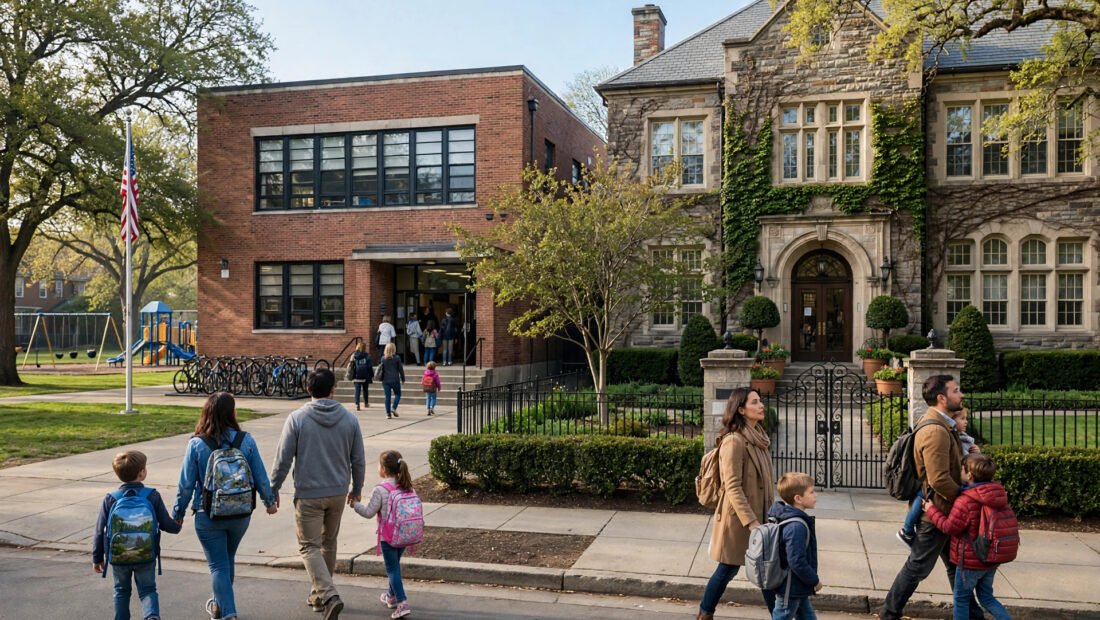
Texas parents weighing public versus private school face one of the most emotionally charged — and financially consequential — decisions of family life. Private tuition in Texas metros runs $10,000–$30,000+ per year per child; over K-12, that is a house. Advocates on both sides speak with religious certainty. But the research paints a more nuanced picture than either camp admits, and the right choice depends on your specific child, your specific options, and your honest finances. Here is how to decide clearly.
What the Research Actually Says
The headline finding surprises most people: once you control for family background, the academic advantage of private schools shrinks dramatically. Large-scale studies (including analyses of NAEP data) find that much of the private-school test-score advantage traces to who attends — children of affluent, education-focused families — rather than the schools themselves. A motivated student with involved parents tends to thrive in either setting.
Where private schools show more consistent edges: smaller classes (though many Texas public schools in affluent suburbs match private class sizes), school culture fit (religious values, pedagogical philosophy, peer environment), specialized programs (certain arts, languages, or special-needs approaches), and networks (elite privates feed elite colleges — a real, if narrow, advantage). Where public schools often win: diversity of experience (economic, cultural, and neurological diversity that mirrors the real world), special-education resources (public schools are legally required to provide extensive services; privates are not), extracurricular breadth (large publics field more teams, clubs, and programs), and cost (obviously — $0 tuition funds a lot of tutoring, travel, and college savings).
The Financial Math (Be Brutally Honest)
Run the full 13-year number: $15,000/year × 13 years = $195,000 per child — before annual increases. Two children: nearly $400,000. Now ask what else that money buys: full college funding (a Texas public university degree costs roughly $100,000 all-in), intensive tutoring for any struggle, enrichment travel, or simply financial security. The question is never “is private school good?” — it is “is it $200,000 better than our public option for this child?” For families where tuition means genuine sacrifice (no retirement savings, no emergency fund), the honest answer is usually no — financial stress harms children more than school type helps them. And remember the ongoing costs beyond tuition: uniforms, trips, fundraising expectations, and the social pressure of affluent peer environments.
Evaluate Your Actual Public Option
“Public school” is not one thing — it ranges from exemplary suburban campuses to struggling urban ones. Evaluate yours: tour it with a critical eye (the principles of a thorough school tour apply at every level), check Texas accountability ratings with appropriate skepticism, talk to current parents (not just the loudest critics), and assess the specific teachers and programs your child would access. Many Texas suburbs offer public schools rivaling privates on every metric that matters. If your zoned school is genuinely weak, remember Texas options: open-enrollment charters (free), magnet programs, and intradistrict transfers — all before private tuition enters the picture.
When Private School Is Worth It
Values alignment: faith-based education or specific pedagogies (Montessori, classical, Waldorf) unavailable publicly. Specific needs: certain learning differences served better by specialized private programs (though verify — many publics serve these well). School fit crisis: bullying, severe anxiety, or a child fundamentally mismatched to the local public culture — sometimes the environment change is the intervention. Affordability without sacrifice: tuition comfortably fits the budget with financial aid (many Texas privates offer substantial aid — always ask). Elite trajectories: for the narrow path of elite-college admissions, top privates’ counseling and networks provide real advantages — weigh honestly whether that path is your child’s.
When Public School Wins
Strong local public option: the most common case — good zoned schools make private tuition a luxury, not a necessity. Special-education needs: public schools’ legal obligations (IDEA, Section 504) guarantee services privates can decline. Financial prudence: when tuition would strain the family, the public-plus-enrichment strategy (tutoring, camps, travel, college fund) usually delivers more total development per dollar. Social realism: diverse public environments build adaptability, empathy, and comfort with difference — genuine life skills. Teen autonomy: large publics offer more course variety, clubs, and social options for self-directed teens.
Questions to Ask Each School
For any school, public or private: How do you handle a child who is ahead/behind? What is teacher turnover? How do you approach discipline? What does a typical day look like (not the brochure version)? How do parents communicate with teachers? For privates specifically: What is the real annual cost including fees, trips, and expected giving? What financial aid exists, and how do we apply? What accreditation do you hold? What are college outcomes for students like mine? And for the digital dimension of modern schooling, our guides to parental controls and AI in school projects help you evaluate tech policies.
The Hybrid Approach: Mixing Sectors Strategically
The savviest Texas families do not treat this as a once-and-forever decision — they mix. Public elementary, private secondary: the most common hybrid — young children thrive in good public elementaries (where the fundamentals are well-taught and the social world is broad), while private middle/high schools offer the college counseling, specialized programs, and peer culture families value most in the high-stakes years. This concentrates spending where research suggests it matters most. Private elementary, public secondary: less common but sensible when early reading instruction or a specific learning need demands specialized attention young, while large public high schools offer the course variety, teams, and social breadth teens want. Public plus targeted private supplementation: the budget optimizer — public school plus private tutoring for struggles, summer programs for enrichment, and test prep when it counts — often delivers 80% of private-school benefits at 20% of the cost. Charter and magnet mixing: Texas’s open-enrollment charters and magnet programs let families access specialized public options (STEM academies, fine-arts magnets, dual-language programs) without private tuition — apply broadly, as lotteries are competitive. The key insight: optimize per stage, not per ideology. Your kindergartner’s needs differ from your sophomore’s; the school decision can evolve with them. Revisit every 2–3 years with fresh eyes: tour again, reassess fit, and adjust. Data to ground these decisions lives at the National Center for Education Statistics (enrollment, outcomes, and finance data by school type) and the Department of Education’s school-choice resources — use evidence, not tribal loyalty, at each decision point.
Conclusion
The public-vs.-private decision is not a referendum on your parenting — it is a fit-and-finance optimization for a specific child at a specific school. Research says the school matters less than family factors; economics says the tuition must clear a very high bar; and your child says (listen closely) where they will actually thrive. Tour both seriously, run the 13-year math honestly, and choose the environment where your kid will be known, challenged, and happy. That school — public or private — is the right one.
Frequently Asked Questions
Do private schools provide better education than public schools?
Not inherently — research shows most of the achievement gap traces to family background rather than school type. School fit, teacher quality, and parental involvement matter far more than the public/private label.
How much does private school cost in Texas?
Typically $10,000–$30,000+ per year depending on metro and prestige, plus fees, uniforms, trips, and fundraising. Over K-12, families commonly spend $150,000–$400,000 per child.
Is private school worth it for elementary grades?
Usually the weakest ROI years — young children thrive on warmth, play, and reading instruction, which good public schools provide well. The investment case strengthens in later grades for specific needs (fit issues, specialized programs, college counseling).
Can I switch between public and private school?
Yes, in either direction, at natural transition points (elementary to middle, middle to high). Many families use public elementary, private middle/high school, or vice versa — optimizing spend for the years where it matters most for their child.