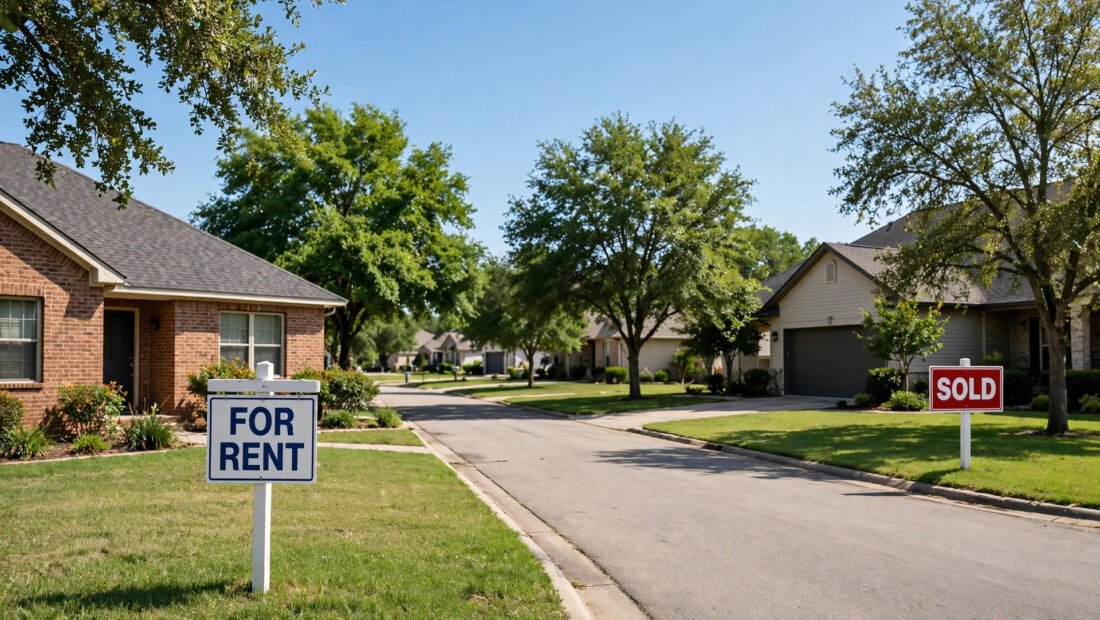
“Renting is throwing money away” might be the most repeated — and most misleading — personal finance slogan in America. It sounds like math, but it’s mostly marketing: from landlords, from the real estate industry, and from a culture that equates ownership with adulthood. The truth is more interesting. Renting is buying something very real (housing + flexibility + freedom from maintenance), and buying is “throwing money away” on interest, taxes, insurance, and repairs — often more than renters spend on rent. This guide does the actual math for Texas in 2026 and shows you when each choice wins.
What Renters Actually “Throw Away” (And What They Don’t)
The slogan’s logic: rent payments build zero equity, while mortgage payments build ownership. What’s omitted: in the early years of a 30-year mortgage, the majority of each payment is interest, property taxes, and insurance — money that builds no equity either. On a $350,000 Texas home at 2026 rates, year-one “thrown away” costs (interest + ~$6,000 property taxes + ~$2,500 insurance + ~$3,500 maintenance) can easily total $25,000–$30,000 — comparable to a year’s rent on a similar property. The renter “throws away” $24,000 in rent; the owner “throws away” $28,000 in non-equity costs plus bears all the risk. Framed honestly, early-years buying is often the worse deal on pure cash flow.
The Real Math: The 5% Rule
Financial planners use a simplified framework (popularized by Ben Felix): the unrecoverable costs of owning run roughly 5% of the home’s value per year — ~3% opportunity cost of capital, ~1% property taxes (higher in Texas — use 1.6–2% here), ~1% maintenance, adjusted for specifics. If 5% of the purchase price exceeds annual rent for a comparable place, renting is likely cheaper; if rent exceeds it, buying likely wins. Example: a $400,000 Texas home × 5% = $20,000/year in unrecoverable ownership costs (~$1,667/month). If comparable rent is $1,800/month, buying roughly breaks even; at $2,200 rent, buying wins; at $1,400 rent, renting wins clearly.
Adjust for Texas: property taxes run 1.6–2.2% (push the rule toward 5.5–6%), but no state income tax and strong appreciation in growth corridors pull back. Run your numbers with the CFPB’s homebuying tools rather than slogans.
When Renting Wins (More Often Than Admitted)
Short timelines: buying and selling within 3–5 years usually loses to renting after transaction costs (6–10% round-trip in agent fees, closing costs, moving). High-cost metros: in Austin’s pricier neighborhoods, price-to-rent ratios favor renting mathematically. Career mobility: renters accept promotions and relocations frictionlessly; owners face a $30,000+ decision every move. Uncertainty: unsure about the city, the relationship, the job? Renting is paying for optionality — and optionality has real value the slogan ignores. Investment discipline: the renter who invests the monthly savings difference (buying costs minus rent) in index funds often outperforms the owner’s equity growth — the catch being most renters spend the difference instead.
When Buying Wins
Long timelines (7+ years): transaction costs amortize, principal paydown accelerates, and rents rise while your payment stays fixed — the math compounds in your favor yearly. Stable life: committed to the city, the job, the schools — buying converts housing from an expense to a forced-savings plan. Texas growth corridors: buying in appreciating areas (with due diligence, not speculation) has historically built substantial equity. Control: renovations, pets, stability for kids — non-financial returns that matter enormously and don’t appear in spreadsheets. Inflation hedge: fixed-rate mortgages are short-inflation positions; as rents and wages rise over decades, your payment doesn’t.
If buying wins for you, go in prepared — our guide to what every new homeowner should know in the first month covers the costs and surprises that ambush first-timers.
The Rent-and-Invest Strategy (Done Right)
Renting wins financially only if you invest the difference — this is the step everyone skips. The protocol: calculate the true monthly cost of buying (mortgage + taxes + insurance + 1% maintenance reserve), subtract your rent, and automatically invest the difference in a taxable brokerage index fund. A renter saving $600/month this way for 10 years at 7% builds ~$103,000 — real wealth, not “thrown away.” Without the automation, renting’s financial case collapses into lifestyle spending, and the slogan’s critics are proven right by default.
The Non-Financial Ledger
Money isn’t the whole story. Renting buys: mobility, freedom from maintenance (a Texas hailstorm is the landlord’s problem), and lower commitment during uncertain life phases. Buying buys: stability, control, community roots, and the forced discipline of equity building. Neither is morally superior. The right question was never “which throws money away” — it’s “which purchase (flexibility vs. roots, liquidity vs. forced savings) fits my life stage?” Answer that honestly and the math usually follows.
NerdWallet’s rent-vs-buy calculator runs your specific Texas numbers through the full comparison. Whichever side wins your math, the monthly surplus question matters — creating a family budget that actually works keeps housing costs from swallowing your savings.
The “House Hacking” Middle Path
There’s a third option the debate usually ignores: buy, but offset the costs. Rent out a spare bedroom ($600–$900/month in Texas metros), buy a duplex and live in one side, or get roommates for the first few years. This “house hacking” converts the ownership math dramatically — a $2,200 monthly ownership cost offset by $800 in rental income behaves like a $1,400 cost, often beating renting outright while building equity. It requires landlord tolerance and the right property, but for flexible young buyers it’s the highest-expected-value housing strategy available: ownership’s wealth-building with renting’s cash-flow math.
Conclusion
Renting isn’t throwing money away — it’s buying housing, flexibility, and freedom from maintenance, often more cheaply than ownership’s unrecoverable costs (interest, taxes, insurance, repairs) in the early years. Buying wins on long timelines, in stable life phases, and when the monthly math favors it — building equity and inflation protection renters can’t get. Run the 5% rule on your actual numbers, automate the savings difference if you rent, and choose based on your timeline and life stage rather than slogans. The only truly “thrown away” money is housing spending chosen for cultural pressure instead of personal math.
Frequently Asked Questions
Is renting really throwing money away?
No — rent buys housing, flexibility, and freedom from maintenance costs. In early mortgage years, owners “throw away” comparable amounts on interest, taxes, and insurance while building little equity.
How long should I plan to stay for buying to make sense?
Generally 5–7+ years, so transaction costs (6–10% round-trip) amortize and equity building outpaces renting. Shorter timelines usually favor renting mathematically.
What is the 5% rule in rent vs. buy?
Unrecoverable ownership costs run ~5% of home value yearly (opportunity cost, taxes, maintenance). If that exceeds annual rent for a comparable home, renting is likely cheaper.
Does renting ever build wealth?
Yes — if you invest the monthly savings difference between renting and owning costs. Automated investing of that gap in index funds builds real wealth; spending it doesn’t.
What about buying a condo instead?
Condos split the difference — lower prices and maintenance like renting, equity-building like owning — but HOA fees can erase the advantage. Run the same 5% math including HOA fees before deciding.
Are Texas property taxes a factor in rent vs. buy?
Significantly — at 1.6–2.2% of value annually, Texas property taxes add hundreds monthly to ownership costs, tilting the math toward renting more than in low-tax states. Landlords pass taxes through in rent, but more gradually.