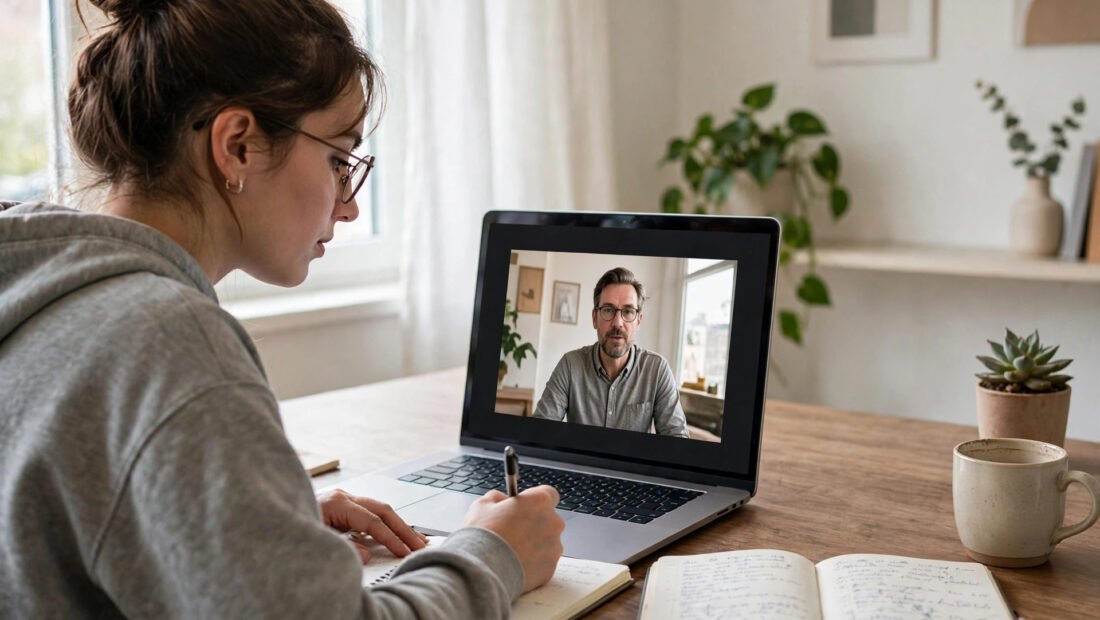
Is online learning actually as effective as sitting in a classroom? The honest answer splits three ways: by subject, by the quality of the course, and by the student taking it. A well-built online course on a lecture-based subject, taken by a student who manages time well, can work just as well as the classroom version. A recorded set of lectures in a subject that needs hands, eyes, and live correction, taken by a student who struggles to start work without a set time and place, usually does not. The two formats are compared head-on below, across the points that actually decide the outcome, and the recommendation at the end is a blend rather than a winner.
What the Broad Research Picture Shows
Large reviews that compare many courses at once tend to reach a similar broad finding: students in well-designed online courses learn about as much, on average, as students in face-to-face courses, based on test scores and similar measures. Blended courses, which mix online material with live sessions, often perform as well or slightly better than either format alone. That is the general shape of the evidence, and it comes with heavy conditions.
The first condition is design. Most of the favorable findings come from courses that were built for online delivery, with interaction, feedback, and clear structure planned in. Hastily moved lectures, the kind many students met during emergency remote teaching, are a different product, and they should not be judged as the same thing. The second condition is range. An average that looks equal can hide strong results at one end and poor results at the other. So the useful question is not which format wins overall. It is which format fits a given subject, course, and student. The sections below take those one at a time.
Flexibility and Access: Where Online Pulls Ahead
Online learning wins clearly on access. A student can watch lectures at midnight, pause them, replay a hard section three times, and fit study around a job or a family. That flexibility is not a luxury for many Texas students. A large share of Texas college students work substantial hours alongside their studies, and for them a rigid daytime schedule may not be a worse option. It may be no option at all. Students in rural areas, hours from the nearest campus, face the same math. So do parents and students whose health or disability makes daily travel costly.
In-person classes cannot match this, and they do not try to. Their schedule is fixed because the room, the instructor, and thirty other students must all be in one place at one time. That rigidity has costs, but it also has a hidden benefit, covered in the structure section below: the fixed schedule does the organizing for the student. Online removes the travel and the timetable. It also removes the built-in push to begin.
Hands-On Work: Where In-Person Pulls Ahead
Some learning happens through the hands and eyes, and screens carry it badly. Nursing clinical practice, chemistry and biology labs, welding and other skilled trades, engineering workshops, and studio art all depend on physical practice, real equipment, and an instructor who can see an error and correct it on the spot. Simulations and videos can prepare a student for that work, and they are useful for review, but they do not replace holding the instrument, mixing the compound, or treating a real patient.
Discussion-based seminars sit closer to this end than many people expect. In a good seminar, the live exchange is the lesson: students test arguments against each other, and the instructor steers in real time. A discussion board can hold a slower version of that exchange, and some students write more thoughtfully than they speak. Still, the pace and energy differ, and something real is lost. Lecture-heavy subjects sit at the far end. History surveys, introductory psychology, business fundamentals, and much writing instruction lose the least online, because the core activity, taking in material and responding in writing, transfers well.
Structure and Self-Discipline: The Deciding Factor for Many Students
Ask who finishes online courses and who quietly stops logging in, and one trait keeps appearing: self-regulation. Students who can set their own schedule, start without being prompted, and keep going without social pressure tend to do well online. Students who rely on the classroom to supply that structure often drift. Recorded lectures are easy to postpone. Discussion posts get written at the last minute or not at all. Completion rates for fully online courses run below those of in-person courses, and the gap tends to be widest for students who arrived less prepared.
None of this is about intelligence. An eighteen-year-old managing time alone for the first time is being asked to do something genuinely hard, and a fixed class meeting quietly does half of that work for them. Be honest in the self-assessment. A student who did well in structured high school classes but has never held a self-directed routine should treat fully online study as a risk, not a convenience. A working adult with years of deadlines met without supervision has already proven the skill the format demands. While weighing the format, it also helps to weigh the credential itself, and the real difference between a BA and a BS degree matters more for graduate school plans than the delivery format usually does.
Cost: Real Savings, With Fine Print
Online study often costs less overall. Tuition may be similar, but the costs around tuition drop: no move to a college town, no daily commute, no campus housing contract. For a student living at home and working part-time, those savings can decide whether college happens at all. Course fees can claw some of it back, though. Proctored online exams, technology fees, and required software sometimes appear on top of the headline tuition, so compare the full bill, not the advertised rate.
In-person study costs more and returns things that are hard to price: the library, the labs, the office hours down the hall, and the daily presence among other students. Whether those are worth the extra money depends on how much a student uses them. A student who attends every class, joins study groups, and visits professors is buying something real. A student who skips lectures and studies alone from slides is paying campus prices for a mostly solitary product.
People, Mentors, and the Life Around Class
College teaches more than course content. Professors who know a student can write strong recommendation letters, point them toward internships, and notice when they are struggling. Classmates become study partners, friends, and later, professional contacts. Much of that grows out of unplanned contact: the chat before class, the question after it, the group that forms in the library. Online courses can support community through group projects, live sessions, and active discussion, and good programs work hard at it. But the contact must be designed, because it will not happen by accident through a login page.
First-generation students feel this difference most. A physical campus surrounds them with informal guidance: how to approach a professor, where the tutoring center is, which deadlines matter. Online students must seek each of those things out by name, often without knowing the name. Strong online programs answer this with dedicated advisors and proactive check-ins. Weak ones hand over a password and wish the student luck.
How to Judge a Specific Online Program
Because quality varies more online than in person, vet the actual program rather than the format. Check accreditation first, through the U.S. Department of Education’s database rather than the school’s own claims; regional accreditation is the standard that employers and other universities recognize. Then look at how students interact: live sessions, facilitated discussion, group work, and feedback from instructors all signal a designed course, while a list of recorded lectures with automated quizzes signals a content dump. Ask about support for distance students specifically, including advising, tutoring, tech help, and career services. Ask for the program’s own graduation and completion numbers. Established universities offering online degrees under their own name are generally a safer bet than unfamiliar schools with aggressive recruiting, promises of very fast degrees, or pressure to enroll today.
Students comparing programs can also use College Board’s BigFuture resources on choosing a college program to line up costs, majors, and graduation data side by side before committing.
The Recommendation: Mix by Course, Not by Loyalty
Neither format deserves a blanket verdict, and students rarely have to choose only one. The practical recommendation is to decide course by course. Take lecture-heavy and writing-heavy courses online when the program is well built, especially if work or distance makes attendance costly. Take labs, clinicals, studios, and discussion-driven courses in person whenever they are offered. Where a hybrid section exists, with content delivered online and live time reserved for problems, discussion, and practice, treat it as the default first choice, since blended formats often perform as well or better than either pure format.
Then match the choice to the student, honestly. Strong self-managers gain the most from online flexibility and lose the least. Students who know they need external structure should protect that structure, even if it costs more time and travel. The format is a tool. Used where it fits, online learning is a genuine equal. Used where it does not, it becomes an expensive way to fall behind quietly.