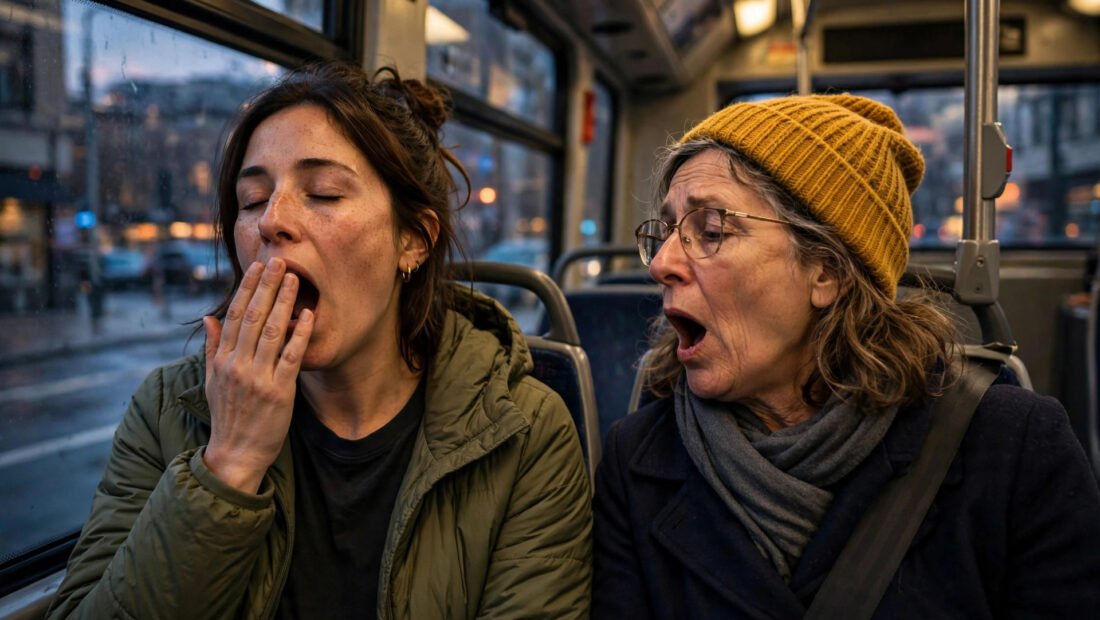
If you yawn while reading the next few paragraphs, do not feel rude. A fair share of readers will. Reading about yawning, hearing the word, even thinking about a wide-open jaw can set one off, which is part of what makes the habit so odd. A yawn feels trivial, yet it shows up in the womb, across much of the animal world, and in boardrooms where everyone swears they slept fine. The questions below follow the order most people ask them, from the stretch itself to the point where frequent yawning deserves a doctor’s attention.
What actually happens in your body during a yawn?
A yawn is a fixed sequence, not just a big breath. Your mouth opens wide, your jaw drops and stretches, and you pull in a long, deep breath. The muscles around your face, neck, and ears tense. Your eyes often water or squeeze shut. Then comes a shorter exhale and a quick sense of release. The whole thing lasts about six seconds on average.
Once a yawn starts, it is very hard to stop halfway. Trying to clamp your mouth shut usually produces a strained, half-finished version that satisfies no one. That all-or-nothing quality tells researchers the yawn is run by deep, old wiring in the brain stem rather than by conscious choice. Babies yawn before birth, observed on ultrasound as early as about eleven weeks into pregnancy, long before they could have learned it from anyone.
Why do we yawn at all?
No single answer has settled the argument, and honest researchers will tell you that more than one job may be going on at once. Two ideas carry most of the evidence.
The first is brain cooling. Your brain works best within a narrow temperature range, and it heats up with effort and tiredness. A yawn pulls in cooler air, stretches the jaw in a way that pumps blood around the skull, and may help move warmer blood away. Together, those effects could drop brain temperature by a small but useful amount. In tests of this idea, people holding a cold pack to the forehead yawned less while watching yawn videos, while a warm pack had the opposite effect. Cooling the brain, on this account, is a way of sharpening it.
The second idea is about state change. Yawns cluster at turning points: waking up, drifting toward sleep, shifting from focus to boredom, or bracing before a performance. Athletes yawn in locker rooms. Speakers yawn backstage. Students yawn in the first minutes of a dull class, not the last. On this view, a yawn is a reset signal, a brief jolt of muscle tension, heart rate change, and fresh air that nudges the brain from one mode into another.
The two ideas are not enemies. A cooler brain may also be a more alert one, and a reset may work partly through temperature. What the evidence rules out, mostly, is the simple answer most of us grew up with, which gets its own question below.
Is yawning really contagious?
Yes, in a sense you can measure in a lab. When adults watch video of strangers yawning, roughly 40 to 60 percent of them yawn in response, even when they have been told to try hard not to. Hearing a yawn can do it. Reading the word repeatedly can do it. Some people yawn at the mere sight of an open mouth mid-stretch in a photograph.
Animals share the habit. Dogs catch yawns from people, and they seem to catch them more readily from their own owners than from strangers. Chimpanzees yawn after watching yawns from members of their own group. This is not mimicry in the deliberate sense. Nobody decides to copy. The sight lands, and a few seconds later the jaw opens on its own.
The trigger does not even need a live person in the room. A yawn on a video call can start a chain across three time zones, each face on the screen setting off the next a few seconds later. Sound alone, played to people who cannot see the yawner, works on some listeners too. That spread of triggers, sight, sound, word, and thought, is part of why the habit is so hard to study cleanly. The stimulus is almost everything, and the response sneaks up before willpower gets a vote. People told to suppress a yawn often produce a tight, disguised version instead, jaw clenched and breath leaking, which researchers count as a yawn that lost an argument rather than one that never started.
If the topic leaves you curious about rest more broadly, MedlinePlus’s medical encyclopedia resources on sleep and the brain offer a solid, plain-language starting point for how sleep and alertness fit together.
Why do some people catch yawns and others never do?
Age matters first. Small children rarely catch yawns. Contagious yawning usually appears around age four or five and grows stronger as social skills develop. At the other end of the scale, older adults tend to catch yawns a little less often than younger adults do.
Closeness matters too. You are more likely to catch a yawn from family and close friends than from a stranger, with acquaintances falling in between. Familiarity seems to tune the response up. Attention plays a part as well. A person scrolling a phone may miss the yawn entirely, while a person watching faces closely is primed to respond.
Researchers have also linked contagious yawning to empathy, the ability to pick up on what someone else is feeling. People who score higher on standard empathy measures often yawn more in response to others, and brain scans during contagious yawning show activity in regions tied to understanding other minds. Treat that link with care, though. It is a group-level pattern, not a character test. Plenty of kind, attentive people rarely catch a yawn, and plenty of champion yawn-catchers are no saints. Failing to yawn in a meeting proves nothing about your heart.
Does yawning top up your oxygen?
No. This is the myth that refuses to die, and it has been tested directly. In experiments, volunteers breathed air with extra oxygen or extra carbon dioxide, and their yawning rates barely moved. Breathing through the mouth versus the nose made no real difference either. If yawning were an oxygen rescue tool, those changes should have switched it on and off. They did not.
Tiredness itself is also a weaker trigger than people assume. Feeling worn out and yawning often travel together because both show up at the edges of the day and during boring, low-stimulation stretches. That overlap is probably why the oxygen story felt so convincing for so long. If you are puzzling over why you are still tired after eight hours of sleep, oxygen during a yawn is not where the answer hides.
Why does Texas heat seem to bring yawns on?
This is where the brain-cooling idea gets an interesting test. If a yawn cools the brain by pulling in outside air, it should only help when that air is cooler than the body. Studies of contagious yawning across seasons fit that logic. People catch yawns less often on very hot days, when the air offers no cooling at all, and more often in mild conditions when a deep breath could actually move the temperature needle.
So why does a long August afternoon in Houston seem to produce yawns on every porch? Heat also makes people drowsy, slows activity, and pushes the brain toward the low-alert state where yawns cluster for state-change reasons. Both effects can be true at once. Your summer yawns may be less about cooling that no longer works and more about a tired, overheated brain asking for a reset. Scientists still treat the temperature details as an open question, so be wary of anyone who states the summer pattern as settled fact either way.
When does yawning become a medical concern?
For almost everyone, yawning is harmless and needs no treatment at all. Excessive yawning is a different matter. Yawning many times an hour, day after day, especially when you are sleeping enough, is worth mentioning at a checkup. It can ride along with sleep disorders that fragment rest, such as sleep apnea. It can appear as a side effect of certain medicines, including some antidepressants. In rarer cases, frequent yawning shows up around problems with temperature regulation or, very occasionally, ahead of a faint or a seizure in people who already have those conditions.
The line is simple. A yawn in a boring meeting is ordinary life. Yawning that is new, constant, paired with crushing daytime sleepiness, loud snoring, morning headaches, or episodes of nearly passing out deserves a real conversation with a clinician. Bring notes on when it happens and what medicines you take, since those details help more than the yawn count alone.
So what should you make of your own yawns?
Treat them as signals, not flaws. A yawn usually marks a brain in transition: waking, fading, bored, or bracing. You cannot fully suppress one, you will probably catch a few from the people closest to you, and on a mild day the stretch may even help cool the organ doing all that thinking. Yawn without apology, cover your mouth out of courtesy, and only worry when the pattern changes in ways that stick around. And if you made it to the end without yawning once, congratulations. You are in the resistant minority, at least until the next meeting.