
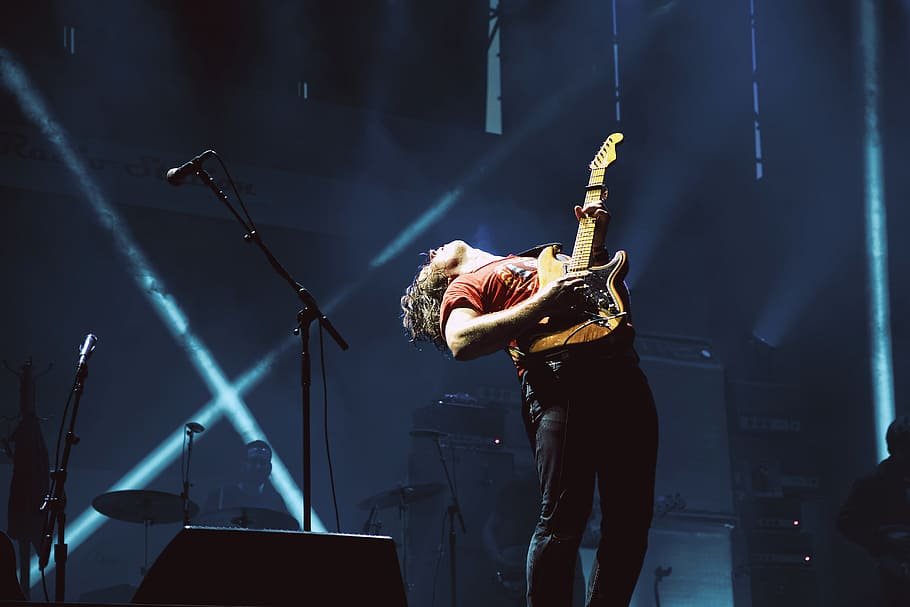
Listen to a good live recording of the Grateful Dead and one sound stands apart: a lead guitar that is clean, bright, and almost vocal, singing above the band instead of fighting through it. That tone feels like it should require rare vintage gear and a technician’s notebook. It does not. Jerry Garcia’s sound came from a short chain of ordinary choices, each one easy to copy on its own. The chain starts with the guitar itself, not with a pedal, and every link after that either protects the brightness of that first choice or quietly takes it away. Build the chain in order, and an affordable setup gets surprisingly close.
What You Need Before You Start
Gather the gear first, because chasing this tone with the wrong basics wastes weeks of knob turning. You need the following:
- A Strat-style guitar with single-coil pickups, or any bright single-coil guitar you already own
- Medium strings, roughly .011 to .049 gauge, fresh rather than months old
- A clean amplifier with good headroom, meaning it stays clean when played fairly loud, with bass, middle, and treble controls and built-in reverb if possible
- An envelope filter pedal, also called an auto-wah, which is the one effect that defines the sound
- A standard flatpick, held so your middle and ring fingers stay free to pluck
- Optional extras, only after the basics work: a touch of analog-style delay and a mild distortion pedal for occasional grit
On cost, keep perspective. Garcia’s famous custom guitars, Wolf and Tiger, were one-off builds, and a faithful replica can run to twenty thousand dollars. None of that is required. A Squier Classic Vibe Strat at around four hundred dollars, or any decent Strat-style guitar, supplies the single-coil snap the tone is built on. Money spent past that point should go to the amp and speakers first, not to a fancier guitar. Players building a first setup can also browse Fender’s guitar and amplifier range to see how the Strat and clean-amp pairing Garcia used is still sold at every price level today.
Step 1: Set Up the Guitar
Start where the sound starts. Use the middle pickup. Garcia lived on the middle pickup of his guitars, and it is the least guessed and most important detail in the whole setup. The bridge pickup alone is too sharp, the neck pickup alone is too round, and the middle position gives that hollow, vocal quack that makes his lead lines sound like a voice. If your guitar blends pickups in between positions, the middle pickup on its own is still the home base for this tone.
Fit medium strings, around .011 to .049, and keep them fresh. Old strings lose the top-end sparkle this tone depends on, and no amp setting can restore brightness the strings no longer produce. Medium gauge gives enough body to bend and sustain without turning sloppy, and it suits the medium-low action his fluid playing used. Since strings are a recurring cost rather than a one-time purchase, it is worth knowing what it costs to restring a guitar so fresh strings stay in the budget. Set the guitar volume high and the tone control nearly full up, rolling it back only slightly if your particular guitar sounds harsh.
Step 2: Dial In the Amp for Clean Headroom
Garcia’s core rig used a Fender Twin Reverb, often run as a preamp into a large McIntosh power amplifier driving JBL speakers. That stadium setup is not the lesson. The lesson is the voicing: loud, clean, bright, with strong mids and very little bass. Any clean, bright amp with enough headroom can voice the same way, including a Fender Blues Junior, a Boss Katana on its clean channel, or a good amp simulation at home.
Speakers deserve more credit than they usually get. A widely quoted remark from the founder of Milkman Sound holds that a large share, around seventy-five percent, of Garcia’s tone lived in those JBL speakers, chosen for their clean, clear, extended top end. You cannot easily copy the exact speaker, but you can respect the principle: avoid dark, muffled speaker voicings, and favor clarity over warmth when choosing or setting up an amp for this sound.
Set the controls to these starting numbers, then adjust by ear: bass at 2 to 3, mids at 7 to 8, treble at 8 to 9, volume or gain moderate so the sound stays clean with only the smallest edge of breakup when you pick hard, and reverb at 3 to 4 so it adds air without washing the notes out. The low bass setting is crucial and feels wrong to many players at first. Garcia’s tone has fullness from the boosted mids, not from the low end, and raising the bass turns the singing quality into mud almost at once. If the result sounds thin, add mids before you even think about bass.
A few common amp mistakes are worth naming before the filter goes on. Running the amp too quiet at home shrinks the sound, because a clean amp played at whisper volume loses the body that headroom gives at stage level, so judge your settings at the loudest volume you will actually use, even if that means a short loud test in a garage rather than weeks of quiet tweaking. Scooping the mids out, a popular setting for heavier rock, removes exactly the frequencies that carry Garcia’s vocal quality, so if a shared amp or a borrowed preset sounds hollow, check the middle control first. And stacking gain pedals in front of a clean setup to make it feel more exciting usually buries the clarity the whole chain was built to protect. Clean and present comes first. Excitement in this style comes from the playing.
Step 3: Add the Envelope Filter
One effect turns a clean Garcia-style setup into an unmistakably Garcia sound: the envelope filter. His original was the Mutron III, heard all over songs such as Estimated Prophet and Shakedown Street, where the guitar seems to quack and swell with every phrase. Modern versions, such as the Electro-Harmonix Q-Tron at roughly one hundred fifty dollars, get close for ordinary money.
An envelope filter is an auto-wah that opens in response to how hard you pick. A soft note stays mellow, a hard-picked note opens the filter into that vocal sweep. Because your picking hand controls it, the pedal rewards practice rather than preset hunting. Start with the sensitivity or threshold set so normal picking opens the filter about halfway, and the range or Q control near the middle, around 5 if it is numbered. Then play scales at different strengths until the sweep feels like part of your phrasing. Too much sensitivity makes every note squawk. Too little and the effect vanishes. Add a short delay next, if you want one, set low and warm for a hint of space, and save distortion for rare moments of grit. The filter plus a touch of delay covers most of the recognizable Garcia effects; a long pedalboard is not part of the recipe.
Step 4: Learn the Picking Technique
Gear alone gets you the voicing. Garcia’s hands supplied the phrasing, and skipping this step is why many correct rigs still sound like a tribute act warming up. He played with hybrid picking: a flatpick held between thumb and index finger, while the middle and ring fingers plucked other strings on their own. That mix lets a player roll cascading, piano-like figures that a pick by itself cannot produce, with picked notes and finger-plucked notes alternating inside one line.
Practice it in small pieces. First, hold the pick as usual and pluck the next higher string with your middle finger while the pick plays a lower note, alternating slowly until the two sounds even out. Simple Travis-style patterns, pick on the beat and finger between beats, build the independence without any Garcia solo to copy. Second, lean on legato: hammer-ons and pull-offs that let lines flow like a horn part instead of a row of separate picked attacks. Third, borrow his love of chromatic passing notes, slipping half-step notes between chord tones, which gives his solos that winding, jazzy quality. Fourth, play slightly behind the beat. His lines breathe because they phrase like singing, arriving a fraction late on purpose rather than chasing the metronome.
Step 5: Compare Against a Recording and Refine
The last step closes the loop. Pick one reference recording, a live Eyes of the World or Scarlet Begonias works well, and play along with your setup at a similar volume. Match in this order: pickup and brightness first, then midrange fullness, then reverb amount, then the filter sweep. Change one control at a time, and make small moves. If you sound harsher than the recording, roll the guitar tone knob down slightly before touching the amp. If you sound thin, raise the mids a notch. Every room changes the result, so a setting that sang in a bedroom may need less treble on a stage and less reverb in a hard-surfaced hall.
Know when to stop. The ballpark is a Strat-style guitar on its middle pickup, through a clean amp with bass low, mids and treble high, an envelope filter answering your picking, and hybrid picking shaping the lines. Once those pieces are in place, the remaining distance to Garcia is mostly hours of improvising over songs you love, which is also the part he would have cared about. He rarely played a solo the same way twice. Get the chain right, then spend your time playing rather than shopping, and the tone keeps moving closer on its own.


1 Comment