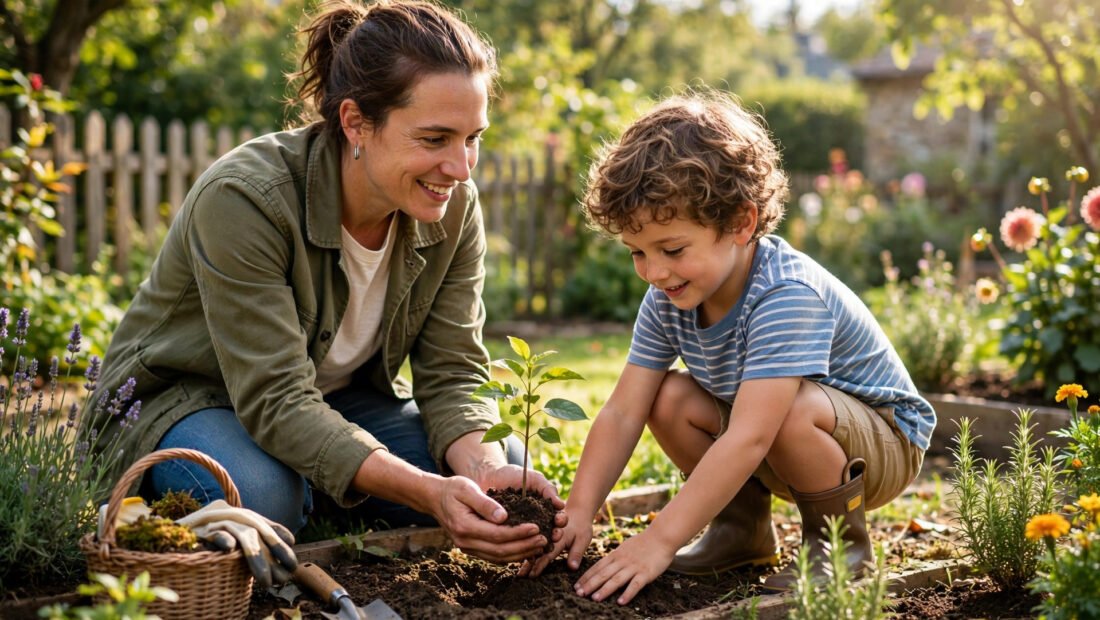
Picture a kitchen table on a weeknight. This is an illustration, not a real family — but the three conversations at that table happen in real homes every week. A five-year-old has seen a short storm clip at school and wants to know if the rain will take the house. A ten-year-old asks plain questions and wants plain answers: why are summers hotter, and are people fixing it? A fifteen-year-old already follows the news on a phone, knows the hard words, and is half angry, half testing whether the adults will be straight. Same table, three very different talks. Handled well, each is short, concrete, and honest — no doom, no lying.
At the table: the five-year-old and the storm clip
She does not need a lesson on the climate system. She needs to know she is safe, what the adults’ job is, and what her small job can be. So the answer stays close to what she can see and touch.
“That was a big storm in the video. Storms can be loud and scary. Our house is built to stay strong in rain, and if a really big storm comes near us, we have a plan and we will be together. Grown-ups who study weather watch the sky and tell us what to do.” Then the pivot to action, small and real: “Our job is to take care of our home and the trees and animals near us. Tomorrow we can water the plant on the porch and put our snack wrappers in the bin. That is how people help.”
Notice what is missing. No timeline. No picture of a ruined future. No promise that nothing bad will ever happen, because she will learn that is not true and the trust will crack. The talk lasts a minute or two. Then it ends. Young children learn through doing and repeating, not through long explanations. Planting a seed, feeding birds, sorting recycling without a lecture — those acts teach care more deeply than any speech at this age.
At the table: the ten-year-old who wants the mechanics
He asks directly, so he gets a direct, simple mechanism. “The Earth is wrapped in air, like a blanket. Some gases in the air hold heat. Cars, trucks, and factories add extra of those gases, so the blanket gets a bit too thick and the Earth gets warmer than it should. Warmer air and oceans change the weather — hotter summers, stronger storms in some places, longer dry spells in others.”
Then, right away, the helpers — because facts without agency sit heavy on a ten-year-old. “Lots of people are working on it. Scientists measure what is happening. Engineers build wind turbines and solar panels. Here in Texas you can see huge wind farms when we drive west. Farmers, builders, and city workers change how they do jobs too. And kids help in real ways — school gardens, cleanups, saving energy at home.” Offer a project with visible results. A garden bed. A classroom recycling push. A family habit he can own, like being in charge of lights in empty rooms. At this age, competence calms fear.
If he asks the big question — “Will it be okay?” — do not dodge it and do not overpromise. A steady answer sounds like this: “The Earth has real problems from this, and people are working very hard to fix them. It will take a long time and it will take all of us helping in different ways. Our family is part of that.” That is honest. It admits uncertainty without handing a child despair. It also leaves the door open for the next question, which matters more than a perfect answer today.
For shared exploring between talks, try NASA Climate Kids’ explainers and activities for children together. Short activities and clear visuals let a curious child follow a question as far as interest goes, then stop — very different from an endless news feed.
At the table: the fifteen-year-old who already knows
She rolls her eyes at the blanket analogy, and she is right to. Teenagers detect softening instantly and read it as disrespect. So the tone changes. Be straightforward about seriousness. Acknowledge frustration without performing it. “You are right to be frustrated. Your generation did not create most of this problem and you will live with more of the effects. That is not fair, and it makes sense to be angry about it.”
From there, talk about meaningful agency, not token gestures. A teenager can see through “turn off the tap while you brush” as a full answer, and offering it alone insults her intelligence. Talk instead about paths with weight: science and engineering study, local flood or heat planning meetings, community projects that actually change a place, and informed civic participation now and voting when eligible. Ask what she cares about most — heat, wildlife, coasts, fairness — and follow that thread. Teens engage when the conversation respects their values, not when adults assign them a script.
Also expect swings. One day she wants to march. The next day she says nothing matters. Both are normal responses to a large problem. Keep the door open, share articles worth reading, and admit what you do not know. Credibility with a teenager is built by consistency over months, not by winning one kitchen-table debate.
The principles underneath all three talks
Three scenes, one method. First, be honest at the right scale. Never lie, but match the amount of detail to what the child can hold. A five-year-old gets safety and care. A ten-year-old gets cause and effect. A teenager gets the fuller picture, including disagreement about policy, while the basic science itself can be presented calmly as settled knowledge.
Second, name the feeling before you add facts. “It makes sense to feel worried about that” does real work. A child who feels heard can listen. A child who feels dismissed stops listening and the worry goes quiet rather than away.
Third, pair every problem with helpers and an action. Agency is the counterweight to fear at every age. The action should fit the child: tiny and hands-on for the young, project-sized for the middle years, consequential for teens. This is also where everyday modeling helps. A home where care is normal practice — saving, repairing, appreciating what you have — teaches steadiness without a lecture. It connects naturally to how to teach your kids to be grateful without lecturing: children absorb what the household does, far more than what it announces.
Fourth, follow the child’s lead. Answer the question that was asked, not the speech you prepared. “Will our house flood?” is a safety question. “Why is it so hot?” is a science question. “Why didn’t adults fix this sooner?” is a trust question. Each deserves its own answer. And fifth, watch your own anxiety. Children borrow calm — or dread — from the adults near them. Have the heavy adult conversations with other adults, in another room, at another time.
Texas fears, answered in place
Place shapes fear. In Texas, children rarely worry in the abstract. They worry about the storm, the heat, or the smoke they have already lived through.
For hurricanes on the Gulf Coast, separate preparedness from dread. Show the family plan out loud: where you go, what you pack, how you hear warnings, who checks on grandparents. A visible plan lowers anxiety because a child can picture what happens next. Do not rehearse worst cases at the table. Rehearse steps.
For extreme heat, keep it practical. Explain in simple terms that some summers are getting hotter, then focus on what the family does: water, shade, rest in the hottest hours, checking on neighbors, never leaving anyone in a parked car. Competence is calming. A child who knows the heat rules feels less at the mercy of the heat.
For wildfire smoke and dry spells, use the same pattern: a brief honest explanation, what firefighters and land managers do, and what your family does — watching air quality, staying inside when smoke is thick, conserving water during drought without panic. Point, when it fits, to real local work: Texas wind and solar buildout, water planning, and local crews who prepare for fire season. “People near us are working on this” lands differently from a vague claim that someone, somewhere, cares.
Lines never to use
Some sentences do damage even when they are meant kindly. Avoid catastrophe language — “the world is ending,” “your future is ruined.” It creates helplessness, not motivation. Avoid loading adult guilt onto small shoulders — “if you forget to recycle, the planet dies.” A child’s actions matter as a contribution, never as culpability for a global problem. Avoid false promises — “nothing bad will happen here” — because one bad storm then breaks trust in everything else you say. Avoid total shielding, too. Children meet this topic at school, from friends, and online. A rumor heard alone at night is almost always scarier than a calm talk at the table. And do not stage adult political fights about the topic in front of young children. The conflict itself frightens them, separate from any facts.
When worry stops being a conversation
Concern is healthy. Sometimes worry grows past what talks and projects can ease. Pay attention if sleep is regularly broken by climate fears, if a child circles the same dread for much of the day, if favorite activities lose their pull, or if stomachaches and headaches show up around news and weather. Nightmares that persist for weeks belong in this group too.
Respond in steps. First, more validation and less exposure: cut back direct news, especially near bedtime, and co-view anything an older child does watch. Second, larger agency: for an anxious child, a bigger, real project often helps more than small tips, because it restores a sense of effect. Third, outside support. A school counselor or a child psychologist can help, and seeking that help is ordinary good care, not an overreaction. Climate worry in children is widely recognized now, and it responds to support.
The table will see this topic again. That is fine. You do not need one perfect talk. You need many honest, right-sized ones — short for the youngest, mechanical and hopeful for the middle child, respectful and real for the teen — each ending with the same quiet message: the problem is real, people are working on it, and you have a place in that work.