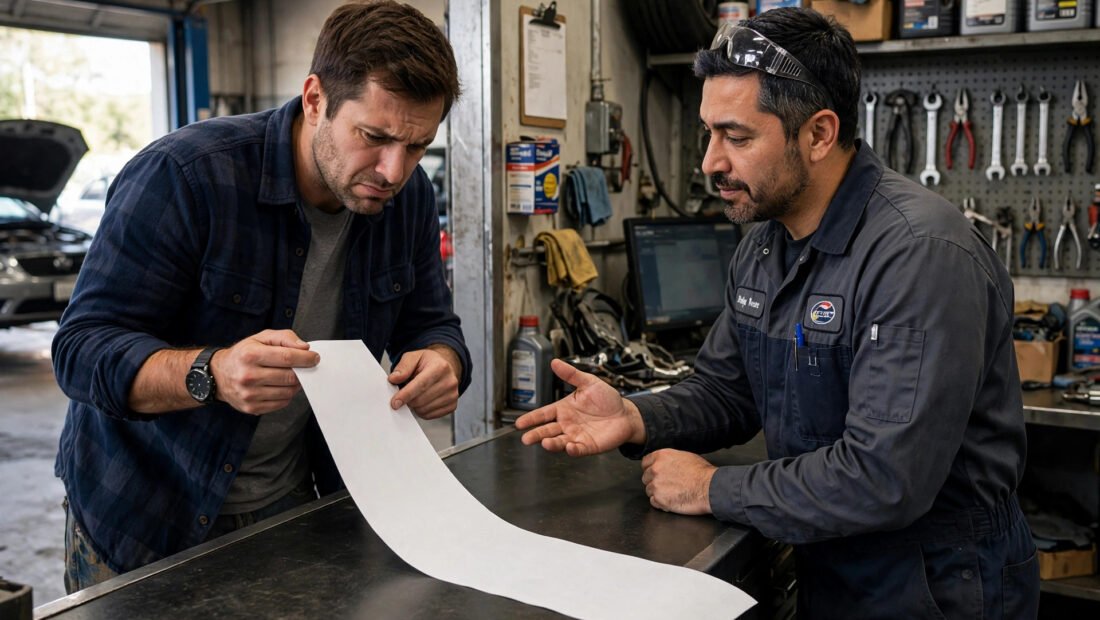
The estimate said $400. The bill on the counter says $1,100. Your car is sitting in the bay, the advisor is waiting, and every line on that invoice seems to need its own translator. Do not sign, do not pay, and do not storm out either. A repair dispute is won in a set order, with paper in your hand and calm in your voice. Work through the steps below in sequence and the odds shift fast, because Texas law is clearer on this than most drivers realize.
Step 1: Pause the Payment and Secure the Paperwork
Your leverage is highest before money changes hands. Once a bill is paid in full, getting money back turns into a long, uphill request. That does not mean you can simply walk away. A shop holds a mechanic’s lien for work you authorized, so it can keep the car until authorized charges are paid. The lien does not stretch to cover work you never approved, and that gap is where your dispute lives.
Ask for the itemized invoice and your original written estimate, then photograph both before you leave the counter. Photograph any paperwork you signed, too. If old parts were replaced, ask to see them. A steady shop will hand them over without drama. A shop that gets vague about invoices, estimates, or parts is giving you useful information about how the rest of the conversation will go.
Stay factual at this stage. You are not accusing anyone yet. You are collecting the two documents the whole dispute depends on: what you agreed to pay, and what you are now being asked to pay.
Step 2: Compare What You Authorized With What Was Done
Lay the estimate and the invoice side by side and mark every line that appears on one but not the other. Texas draws a bright line here. A shop needs your authorization before it does repair work, and the final bill may not exceed the written estimate by more than 10 percent without your further approval. An estimate of $400 supports a bill of $440. It does not support $1,100 unless you approved the extra work along the way.
Sort each charge into one of three piles. The first pile is work you clearly authorized, in writing or in a call you remember. The second pile is work you approved in a limited way, such as a part you said yes to over the phone. The third pile is everything else: work that showed up without any conversation at all. That third pile is the heart of the dispute.
Watch for the classic patterns. A shop that says it noticed your brakes looked bad and went ahead and replaced them has done unauthorized work, however good its intentions sound. An overrun far past 10 percent with no call in between is disputable. If you never got a written estimate at all, say so plainly, because that absence weakens the shop’s position, not yours.
Step 3: Question Every Line in Plain Language
Now go line by line and ask simple questions that demand simple answers. What did the $180 diagnostic fee actually cover, and was any of that testing already part of the repair labor? If a part is listed at $320, what is the part number and what is its list price? Shops do mark parts up, and 30 to 50 percent over wholesale is normal trade practice. A markup far beyond that deserves a direct challenge, not a shrug.
Labor deserves the same treatment. Most common jobs carry a published book time, the standard number of hours the work is supposed to take. If you were billed 4 hours for a job with a 1.5-hour book time, ask the advisor to explain the difference in front of you. Sometimes there is a real reason, such as rusted bolts or extra damage found mid-job. Sometimes there is not, and the question alone brings the number down.
Check for double billing while you are at it. A diagnostic charge stacked on top of repair labor that already includes diagnosis is worth flagging. So is a shop supplies fee that has quietly grown into a large slice of the total. Write down the answer to each question. Short notes with dates and names turn a fuzzy argument into a record.
Step 4: Negotiate With Numbers, Not Adjectives
Ask to speak with the service manager or the owner. Advisors often have no authority to cut a bill, so a long argument at the counter can waste your best energy on the wrong person. Open with the documents, not with anger. The estimate was $400, the bill is $1,100, and no one called for approval in between. That sentence, said calmly, does more work than any insult.
Then propose a specific total. Offer the $440 authorized amount plus the $90 part you approved by phone, for $530 total. A concrete number invites a counteroffer. A general complaint about fairness invites a lecture about costs. Meet a reasonable counter with a small move of your own if the gap is close. The goal is a fair bill you can live with, not a courtroom victory you have to wait months to collect.
Mention your documentation once, without threats. Saying that you have photographed the invoice and saved the estimate tells the shop you are organized. Organized customers get taken seriously, because the shop can see exactly where this goes if the talk fails.
Step 5: Pay the Undisputed Portion and Put the Dispute in Writing
Offer to pay the part of the bill you agree you owe. Paying the undisputed portion shows good faith, weakens any claim that you are simply refusing to pay, and in many cases gets your car released while the rest is argued out. Get a receipt that shows exactly what that payment covered.
On the same day, send the shop a short written summary. Email is fine. State the estimate amount, the billed amount, which charges you dispute and why, the total you have paid, and the resolution you are asking for. Give a clear deadline, such as ten days, for a response. Keep your copy. Every later step, from a regulator complaint to a court filing, runs better with this letter in the file.
Many disputes end here. A written record plus a paid undisputed balance makes settling the sensible business choice for most shops, and plenty of managers would rather adjust a bill than defend it in three different places at once.
Step 6: Climb the Escalation Ladder Only as Far as You Need
If the written complaint gets silence or a refusal, move up one rung at a time. Start with a formal complaint to the shop owner if you have only dealt with managers so far, restating the same facts and the same deadline.
Next, file a complaint through the Texas Attorney General’s consumer protection resources. The Attorney General’s Consumer Protection Division tracks patterns across complaints, and shops know that a file with their name on it is bad news. Filing costs you nothing but a little time.
If you already paid by credit card, call your card issuer about a chargeback for the unauthorized portion. Act fast, because the window to dispute a charge is roughly 60 days from the statement date. Keep your estimate, invoice, and letter ready to send, since the issuer will ask for exactly that kind of proof.
The last rung is Justice Court. Texas Justice Courts handle claims up to $20,000, filing usually costs about $50 to $75, and no lawyer is required. Bring your estimate, your invoice, your photos, your notes, and a one-page timeline. Shops frequently settle once they are served, because sending someone to court over a few hundred dollars costs them more than the dispute is worth. A calm, factual review of your experience, posted after the facts are settled, is also fair game. Stick to what you can prove.
Make the Next Bill Boring
Prevention is cheaper than any dispute. Get a written estimate before work starts, every time, and write a ceiling on the work order: call me before the total passes a set amount. Ask for old parts back before the job begins, which quietly discourages charges for parts that were never fitted. Ask for the labor rate and the book time on any large job, and keep every estimate and invoice in one folder at home.
Drivers who track costs this way tend to spot trouble early in every part of car ownership, the same habit that makes the real five-year cost of an electric car versus gas in Texas clear instead of guessed. Find one honest independent shop before you need one, use it for routine work, and let that relationship carry the big jobs. A shop that knows you, and knows you read your invoices, rarely hands you a $1,100 surprise on a $400 estimate. And if one ever does, you now know the order to work in: pause, compare, question, negotiate in numbers, pay what is fair, put it in writing, and climb only as high as you have to.