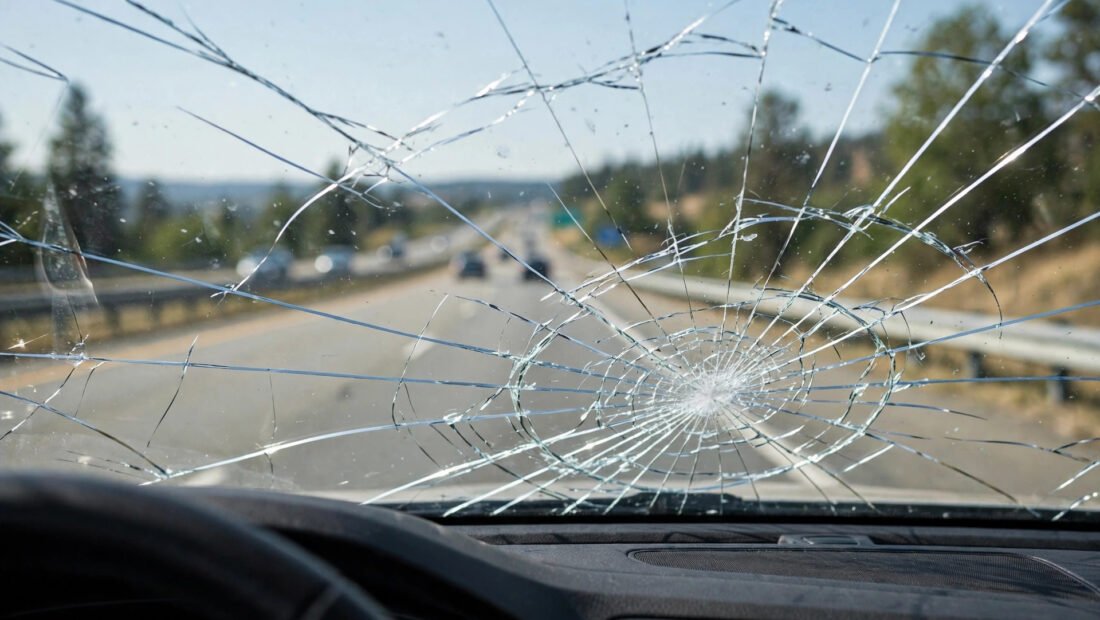
Short answer: a small chip tucked away from your direct line of sight is usually safe to drive on for a short time, and it is often cheap to fix. A crack is a different matter when it blocks your view, stretches past about 6 inches, reaches the edge of the glass, or keeps growing. At that point it is not safe to ignore, and repair may no longer be an option.
The reason goes beyond seeing the road. Your windshield is part of the structure of the car. It provides up to 45 percent of the cabin strength in a frontal collision and up to 60 percent in a rollover. It is also the backstop the passenger airbag pushes against as it inflates. Weak glass can fail at the moment those systems need it most.
Can a small chip wait a few days?
Usually, yes, if it is small, stable, and out of the way. A chip under about an inch across, away from the edge and away from the patch of glass you look through most, can often wait for a booked repair. Cover it with clear tape to keep dirt and water out, park in shade when you can, and avoid slamming the doors, since the pressure pulse through the cabin can make a crack run.
Waiting is not the same as forgetting. Heat alone can turn a chip into a long crack, and Texas heat is relentless on parked glass. A chip you could have filled this week can become a full replacement next month. If the spot grows, changes shape, or sends out a new line, move the appointment up. Growth is the glass telling you its stress limit has been reached.
What kinds of damage can actually be repaired?
Repair works by injecting clear resin into a chip or short crack, then curing it so the spot regains much of its strength and looks far less obvious. The best candidates are single chips under about an inch, including bullseye and star shapes, and short cracks under 6 inches that have not reached the edge.
Location matters as much as size. Damage in the driver’s critical viewing area, roughly the zone cleared by the wipers right in front of the driver, is a poor repair candidate even when it is small. A repair restores strength well, but it can leave slight distortion. Slight distortion at the edge of the glass is a nuisance. Slight distortion where you judge distance and lane position is a safety problem, and good shops will refuse that repair and recommend replacement instead.
Mobile services across Texas handle standard repairs at your home or office in about 30 minutes. Expect roughly $60 to $120 for a chip repair. That price is the bargain of the whole topic, because the same damage, left to spread, leads to a bill several times larger.
When is replacement the only honest answer?
Replace the windshield when a crack is longer than about 6 inches, when any crack touches the edge, when damage sits in the driver’s direct view, or when you have several chips and cracks spread across the glass. Edge damage deserves special care. The edge is where the glass bonds to the frame. A crack there weakens that bond, and the bond is part of what keeps the windshield in place during a crash.
Pitting counts too. Years of sand and gravel can leave the whole surface speckled, so low sun and oncoming headlights scatter into glare. No single pit looks serious, but the combined effect cuts night vision. Replacement is the fix when the surface itself has worn out.
Cost depends heavily on the car. A standard replacement in Texas often runs $250 to $600. Cars with driver-assistance cameras mounted at the windshield cost more, commonly $800 to $1,500 or more, because the cameras must be recalibrated after the new glass goes in. That recalibration alone is often $200 to $400. Some shops skip it to hold a quote down. Do not accept that shortcut. A lane camera aimed a few degrees off can read the road wrong, which is worse than a warning light telling you the system is off.
Glass choice plays into that result. Original equipment glass matches the factory optics most closely. Good aftermarket glass that meets federal standards can work well on a basic car. On a car that needs camera calibration, the safest choice is the glass the shop can calibrate with confidence and will warranty against leaks and defects.
What do Texas law and inspection actually require?
Texas law bars driving with a windshield condition that obscures or interferes with the driver’s vision. That wording gives an officer room to judge the facts in front of them. A tiny chip low on the passenger side rarely draws attention. A crack crossing the driver’s view can draw a ticket, because the interference is easy to see.
Inspection is more mechanical. Damage in the critical viewing area, cracks that impair vision, and missing or broken glass can fail a Texas safety inspection. A failed inspection blocks registration renewal until the problem is fixed, so a crack you meant to handle someday becomes a deadline problem at renewal time. For the official framing, see the Texas Department of Transportation’s vehicle safety and inspection information and your inspection station’s guidance for your county.
Drivers sometimes ask whether a crack outside the wiper sweep can still fail. It can, if an inspector judges that it weakens the glass or will spread into the viewing area, but the most clear-cut failures involve the driver’s view. When in doubt, ask the glass shop to assess it before inspection day rather than paying for a fail and a second trip.
What will insurance do with a chip or a crack?
If you carry comprehensive coverage, chip repair is often covered with no deductible in Texas. Insurers make that choice for simple math. Paying about $80 now for a repair is cheaper for them than paying for a replacement later, so many policies treat repair as the preferred first step.
Replacement is handled differently. The comprehensive deductible usually applies, and that deductible can range from low to high depending on the policy you chose. If your deductible is $500 and a standard replacement costs $450, the claim may gain you nothing. If the car needs camera calibration and the total passes $1,000, the claim may be well worth filing. Read the glass terms in your policy before you book, and compare them with the choices you made when choosing car insurance coverage that actually protects you, since deductible level drives the whole calculation.
Call the insurer or check the app before you pay out of pocket. Many Texas drivers pay for a repair that their policy would have covered in full simply because they assumed glass was excluded. Keep the invoice either way, and note the date the damage happened, since a claim tied to a specific rock strike or hail event is easier to process than a vague report months later.
What can you do today to buy a week safely?
A few small steps can slow the damage while you wait for a slot. Put a small piece of clear tape over a chip to keep moisture and grit out of the break, because a clean chip repairs better than a dirty one. Park in shade or under cover to cut heat stress. Cool a hot cabin gradually rather than blasting cold air straight onto sun-baked glass, since a sharp temperature gap adds stress at the crack tip.
Close doors gently. Skip the high-pressure car wash, which can force water into a chip and push a crack longer. Avoid rough roads and potholes when you have a reasonable alternative route, because each sharp jolt flexes the glass. None of these steps fixes anything. They buy days, not weeks, and they work best when you already have a repair date booked.
Do not use home glass kits as a delaying tactic on damage that needs a professional call. A kit used badly can leave resin or distortion that makes a later proper repair harder. Tape, shade, and a prompt appointment protect your options better than a rushed do-it-yourself attempt on a crack near your sightline.
Why do cracks spread so fast in Texas?
Heat is the main driver. Glass expands as it warms, and a crack concentrates that movement at its tip, so a line that looks stable in the morning can run several inches after an afternoon in direct sun. A car parked outside in August, then cooled hard by air conditioning, cycles through that stress daily.
Gravel adds the starting wounds. Trucks and trailers on highways throw small stones at speed, and long rural stretches give those stones room to reach your glass. Following too closely raises the odds sharply, so a longer following gap protects both your stopping distance and your windshield.
The last spreader is ordinary use. A slammed door, a pothole taken too fast, or a body flex over a steep driveway entrance can finish what heat started. That is why a crack that survived for weeks can suddenly cross the glass on an unremarkable day. The damage was building the whole time. The final jolt just released it.
Common questions, short answers
Is it safe to drive with a crack right in front of me?
No. If the crack sits in your direct line of sight, it can distort distance, scatter light, and fail inspection. Treat it as a replacement job and book it promptly. Driving a short, careful trip to the shop is one thing. Using the car as normal for weeks is another.
How long can I leave a small chip?
Days to a short stretch of weeks at most, and only if it is small, away from the edge, and not growing. In Texas summer heat, lean toward days. The repair is fast and often covered, so delay rarely saves anything.
Will a repair make the spot disappear?
Not fully, in most cases. A good repair restores strength and makes the mark much fainter, but a slight blemish often remains when you look for it. The goal is safety and stopping the spread, not perfect glass. Full clarity means replacement.
Do I need calibration if my car has no fancy features?
If your car has no camera or sensor mounted at the windshield, there is nothing to calibrate. If it has lane keeping, automatic braking, or a rain sensor tied to the glass, ask the shop directly how calibration will be handled and get that answer on the quote.